
Banyuwangi
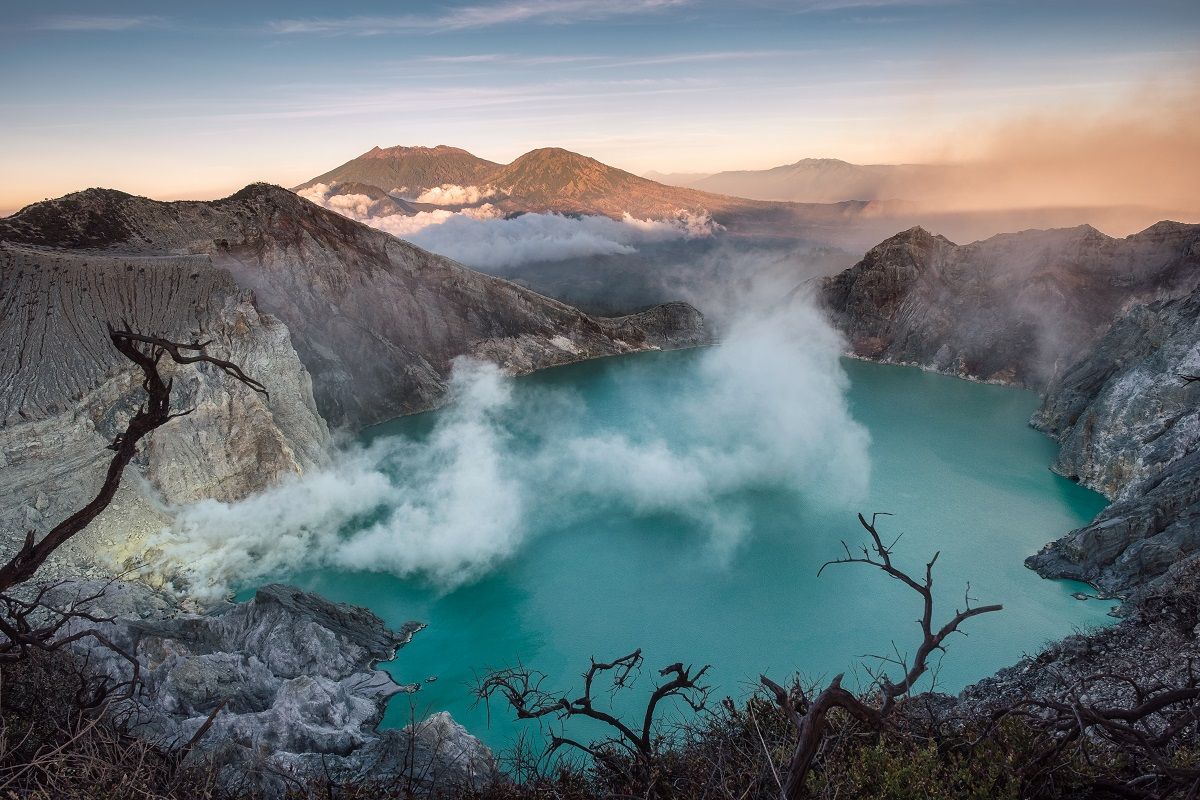
image source : kompas
Banyuwangi is the easternmost city in Java, where the sun first rises each morning, casting its rays over the island. This verdant island has a high population density. Banyuwangi Regency covers an area of 5,800 square kilometers, featuring southern beaches along the Indian Ocean and notable elevations such as Mt Raung at 3,282 meters and Mt Merapi at 2,800 meters above sea level.
Eastern Haven Mountain climbers can ascend from Banyuwangi to the remarkable Ijen Crater, where they can observe the renowned blue flames emerging from the yellow sulfurous rocks, which are manually extracted by traditional miners. It is advisable to refrain from carrying or wearing silver jewellery when observing the blue fire, as the elevated levels of sulphur will cause tarnishing.
Banyuwangi is renowned not only for its blue fire but also as an internationally recognized destination with numerous ideal surfing locations. Plengkung Beach in Banyuwangi is regarded as having the second-best surfing waves globally, following Hawaii.
G-Land, renowned for its surf conditions, features an average of seven rows of waves, which has led to its designation as “The Seven Giant Waves Wonder.”
Red Beach, also known as “Pantai Merah,” serves as an optimal alternative for beginners seeking a lower-risk surfing experience. Red Beach exhibits a significant lack of coral reefs along its shoreline when compared to Plengkung Beach. Red Beach offers impressive sunset views that draw numerous international visitors, leaving them in admiration.
Are you seeking a significant challenge? Navigate the waterway to reach Tabuhan Island, situated between Java Island and Bali Island, approximately 20 kilometers from the town of Banyuwangi. Tabuhan Island offers a unique experience of kite-surfing and wind-surfing, distinguishing it from other beaches.
Exploration of the Natural Environment
Banyuwangi serves as the entry point for observing wildlife in the Alas Purwo National Park, the oldest conservation area on Java Island. Trekking through the savannah of Baluran National Park allows for observation of large Java water buffaloes, referred to as “banteng,” small Java mouse-deer known as “kancil,” as well as peacocks, eagles, macaques, and various other wildlife.
Are you seeking a distinctive location? Green Bay and Sarongan Pesanggaran exhibit remarkable water coloration, transitioning from green at the shoreline to blue as one moves further from the beach. The white sands and tropical environment evoke a comparable experience to that of Bali or Lombok.
Finally, one can visit Sukamade Beach, a site where turtles come to hatch their eggs. Traveling from Banyuwangi offers an opportunity to engage in a genuine experience of jungle exploration within the challenging terrain of Meru Betiri National Park.
Macaques, peacocks, and various endemic bird species can be observed there. When visiting this National Park, it is essential to engage in sustainable tourism practices by refraining from littering and honoring the local community.
Culture refers to the shared beliefs, practices, norms, and values that characterize a particular group or society. It encompasses various aspects, including language, art, religion, and social habits, influencing individual behavior and collective identity.
Blambangan Park serves as a significant landmark in the Banyuwangi Regency. Each evening, the Banyuwangi Tourism Office presents a series of cultural performances under the program titled “Banyuwangi Culture Everyday.” This event serves not only as a tourist attraction but also aims to recognize the talents and hobbies of Banyuwangi’s young artists while preserving the region’s culture.
There are four authentic cuisines of Banyuwangi that one should sample during a visit. Tempong Rice comprises steamed white rice accompanied by steamed vegetables and a raw condiment. This dish is ideal for individuals who enjoy spicy cuisine. For a unique breakfast option in Banyuwangi, Nasi Cawuk is highly recommended. This dish comprises white rice, savory grated coconut, and grilled corn. Nasi Cawuk is additionally garnished with lemongrass sauce and accompanied by steamed clover. One may select a boiled egg or steamed fish as the side dishes. The flavor is notably soothing.
1. Ijen Crater
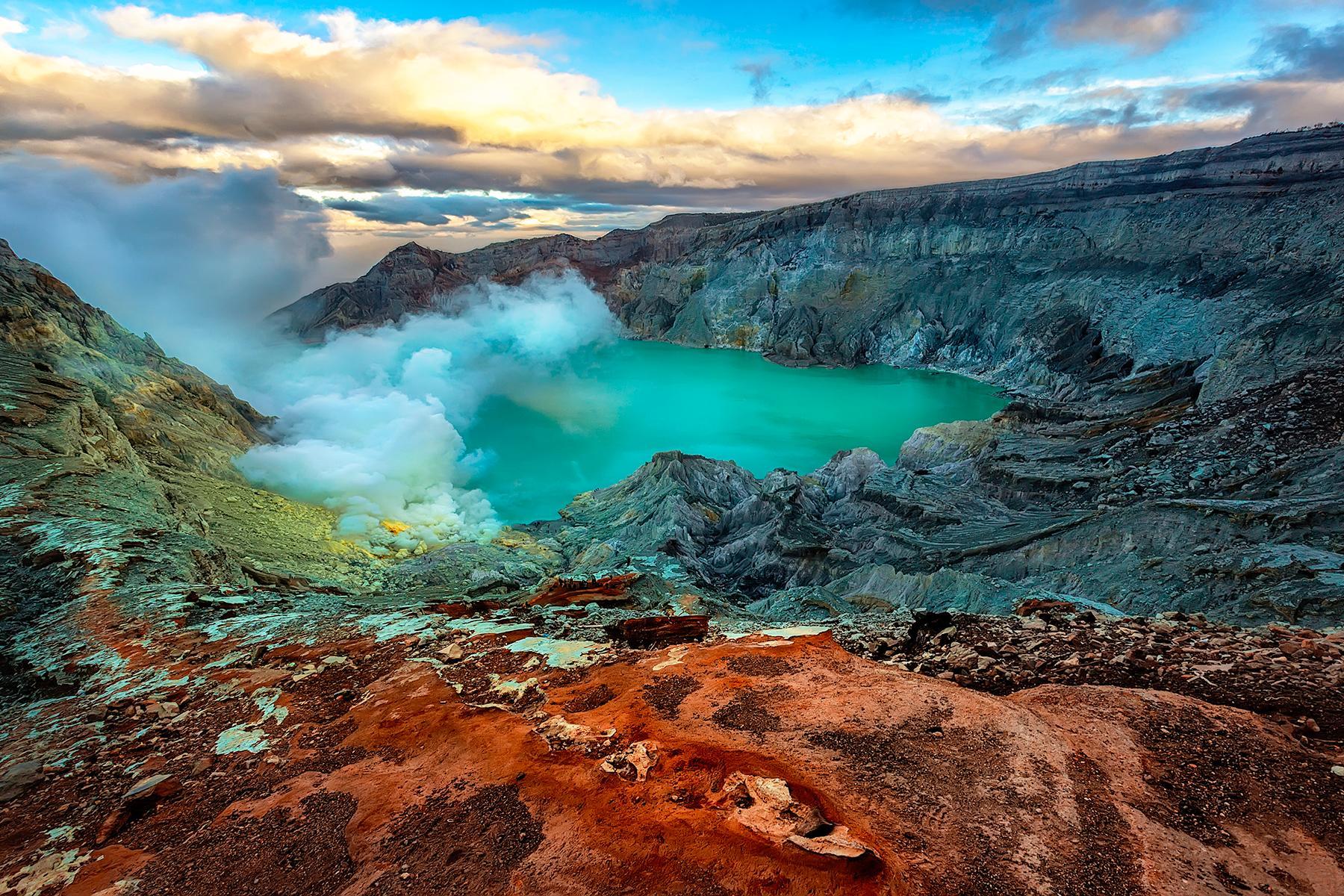
image source : indonesia travel
Ijen Crater’s beauty is acknowledged globally. In March 2016, this lake was designated as a UNESCO World Biosphere Reserve. Upon arrival, one is immediately welcomed by a refreshing breeze after traversing a path bordered by verdant foliage. The ambient temperature surrounding Ijen Crater typically averages approximately 10 degrees Celsius each day. Occasionally, temperatures may reach 2 degrees Celsius. The sight of sunlight reflecting off a turquoise lake surrounded by mist creates a lasting impression. Multiple small vents are located around the crater. They provide employment for sulfur miners, who traverse between the crater and the lake daily. At dawn, one may observe a remarkable natural phenomenon characterized by the appearance of blue-tinted flames surrounding the crater. This phenomenon, commonly referred to as the Blue Fire, typically occurs at approximately 05:00 AM.
2. Baluran National Park
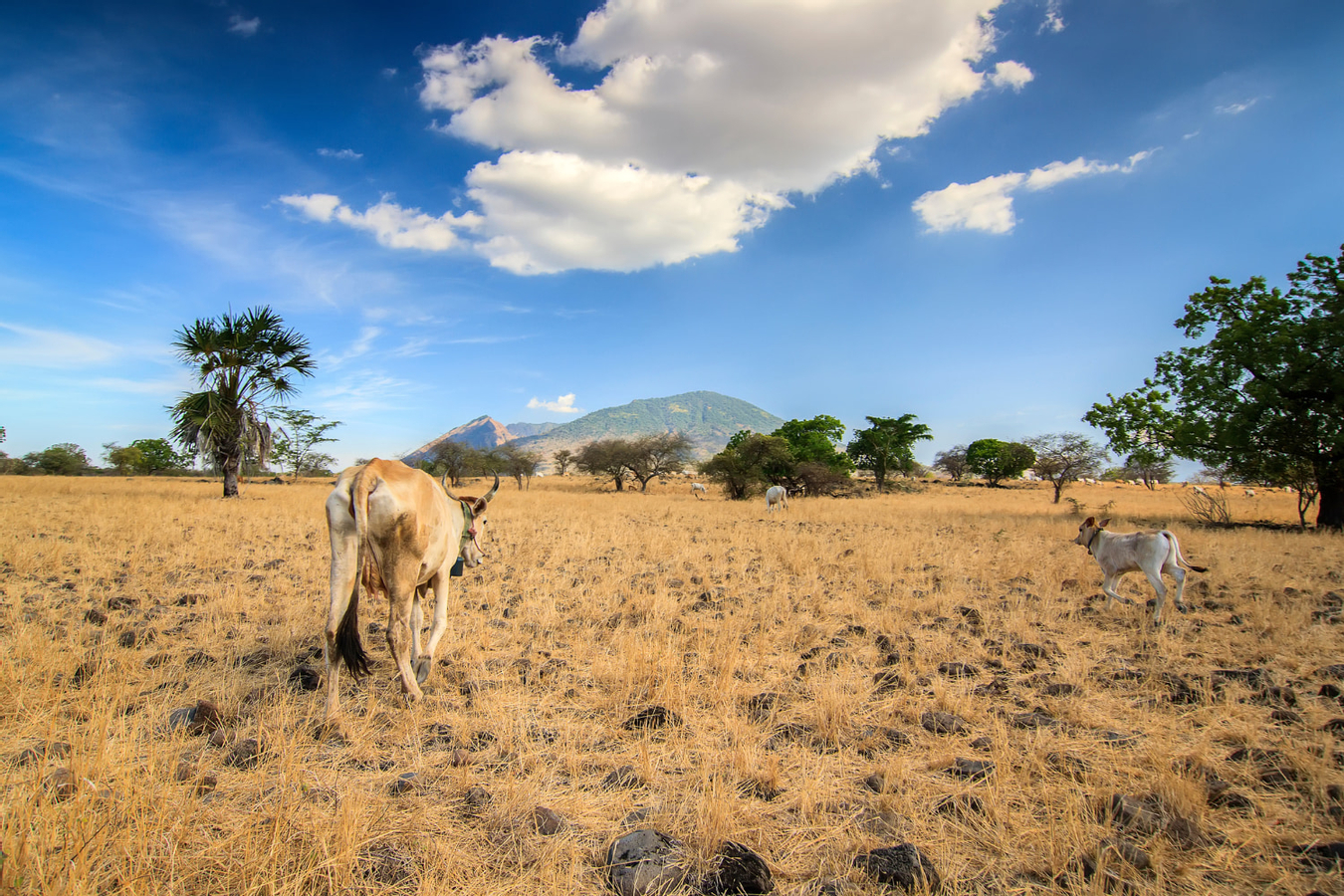
image source : tiket.com
Baluran National Park, situated at the easternmost edge of Java, is characterized by open savannahs, in sharp contrast to the lush green landscapes typical of other areas on the island, where wildlife is observed roaming freely. This location offers the opportunity to observe grazing large Javan water buffaloes, referred to as “banteng,” small Java mouse-deer known as “kancil,” peacocks displaying their vibrant plumage, eagles soaring above, and macaques utilizing their tails to fish for crabs.
The Park spans 250 square kilometers and is located in the Situbondo district of East Java. It includes lowland forests, mangrove forests, and 40% fertile savannahs, which offer ample food resources for the wildlife. This location features several typical Java trees, including the Java tamarind and pecan nut trees.
In 1937, A.H. Loredeboer, a Dutch national, discovered the area, which was subsequently designated a Wildlife Refuge by the Dutch colonial authorities. In 1980, Indonesia recognized it as a National Park. The extinct Baluran volcano is centrally located within this expansive park, overseeing its unspoiled ecosystem. The region is primarily influenced by the dry east wind and receives an average of only three months of rainfall annually. The rainy season in East Java occurs from November to April, with a peak in December and January, while the dry season extends from April to October.
In the dry season, the land becomes parched and water is scarce. Conversely, during rainfall, water flows over the black alluvial soil with minimal absorption, creating pools, particularly in the southern area of the Park that links Talpat with Bama Beach. During the rainy season in Baluran, numerous water holes are present; however, the Banteng and wild bulls tend to remain in the forests. In contrast, other species such as peacocks, mouse deer, and wildfowl are more visible and can be observed.
Baluran National Park contains 444 tree species, including region-specific varieties such as widoro bukol (Ziziphus rotundifolia), mimba (Azadirachta indica), and pilang (Acacia leucophloea). These plants exhibit adaptability to arid conditions, unlike others that have succumbed to wilting. Additional trees that retain their green foliage include the candle tree (Aleurites moluccana), gebang (Corypha utan), api-api (Avicennia sp.), tamarind tree (Tamarindus indica), gadung (Dioscorea hispida), kendal (Cordia obliqua), manting (Syzygium polyanthum), and kepuh (Sterculia foetida).
The Park hosts 26 mammal species, including the banteng (Bos javanicus), wild water buffaloes (Bubalus bubalis), ajag (Cuon alpinus javanicus), muncak deer (Muntiacus muntjak), rusa (Cervus timorensis), leopards (Panthera pardus), mouse deer (Tragulus javanicus), and mangrove cats (Prionailurus viverrinus). The Banteng are endemic to Baluran, thus serving as the Park’s mascot.
Additionally, Baluran is habitat to 155 types of birds, among which are the rare fire kite (Hirundo rustica), the red forest fowl (Gallus gallus), kangkareng (Anthracoceros convecus), hornbills (Buceros rhinoceros), tuwuk or Asian tuwur (Eudynamys scolopacea), peacocks (Pavo muticus), and herons (Leptoptilos javanicus).
A safari trip to Baluran represents a valuable experience.
3. Red Island Beach

image source : trip advisor
Pulau Merah beach was formerly referred to as Ringin Pitu. Two versions exist regarding the name change. One version has it that because the color of the soil and sand are reddish, this is where it got its name from, while another story says that at one time some bright red rays shone from the small hilly Pulau Merah island onto the beach, thus giving it the name Pulau Merah beach. Another feature of the beach is the nearby fishing village called Pancer, where you can stay at villagers’ homes. Their hospitality to visitors despite their simple life is truly heartwarming.
When you wish to explore Pulau Merah Beach, head to Pura Tawang Alun temple. This Hindu temple was built in 1980 and is frequented by Hindus from East Java’s Bromo mountain area as well as from Bali. Unfortunately, the 1994 tsunami destroyed the outer walls of the temple but the inner sanctuary (palinggih padmasana) has remained intact. During the tsunami, a 13-meter wave swept across the village destroying all including parts of this temple.
During your explorations, you will see people wearing bright green uniforms. These are gold miners, at a mine found near the shore. Local villagers, however, are opposed to its existence here since the mine pollutes the sea.
Pulau Merah Beach is one of the many attractive beaches found along the southern coast of East Java. To reach Pulau Merah Beach, you must first fly to Banyuwangi or you can also come in through the airports of Malang or Surabaya, the capital of the province of East Java. The closest airport, however, is Banyuwangi.
Located some 60 KM from Banyuwangi, the beach can be reached by car or motorbike in three hours, near the village of Sumberagung, in the subdistrict of Pesanggaran. Since access roads are smooth, it has become a favorite weekend destination for Banyuwangi residents. It is advisable to hire a car at the airport of Belimbingsari since few public buses are heading to Pulau Merah from here.