
Jakarta
Jakarta, officially the Special Capital Region of Jakarta, is the capital and largest city of Indonesia and an autonomous region at the provincial level. Lying on the northwest coast of Java, the world’s most populous island, Jakarta is the largest metropole in Southeast Asia and serves as the Headquarters of ASEAN. The Special Region has a status equivalent to that of a province and is bordered by the province of West Java to the south and east and Bantento the west. Its coastline faces the Java Seato the north, and it shares a maritime border with Lampung to the west. Jakarta’s metropolitan area has an estimated population of 41.9 million as of 2025, making it the largest urban area in Indonesia and the world;[13] in addition of being ASEAN’s second largest economy after Singapore.
Jakarta is the economic, cultural, and political centre of Indonesia. Although Jakarta extends over only 661.23 km2 (255.30 sq mi) and thus has the smallest area of any Indonesian province, its metropolitan area covers 7,076.31 km2 (2,732.18 sq mi), which includes the satellite cities of Bogor, Depok, Tangerang, South Tangerang, and Bekasi. Jakarta ranks first among the Indonesian provinces in the human development index. Jakarta’s business and employment opportunities, along with its ability to offer a potentially higher standard of living compared to other parts of the country, have attracted migrants from across the Indonesian archipelago, making it a melting pot of numerous cultures.
Jakarta is one of the oldest continuously inhabited cities in Southeast Asia. Established in the fourth century as Sunda Kelapa, the city became an important trading port for the Sunda Kingdom. At one time, it was the overseas administrative center of the Dutch East India Company, as well the Imperial Dutch capital of the Dutch East Indies, when it was known as Batavia. Jakarta was officially a city within West Java until 1960 when its official status was changed to a province with special capital region distinction. As a province, its government consists of five administrative cities and one administrative regency. Jakarta is an alpha world city and the ASEAN secretariat’s seat. Financial institutions such as the Bank of Indonesia, Indonesia Stock Exchange, and corporate headquarters of numerous Indonesian companies and multinational corporations are located in the city. Jakarta, as Indonesia’s largest Muslim-majority city, is known for its tradition of religious tolerance and pluralism. The Istiqlal Mosque, the largest in Southeast Asia, stands as a symbol of the city’s commitment to interfaith harmony.
Most cityscape in Jakarta includes landmarks, monuments, and statues were begun in the 1960s during the Sukarno era, then completed in the Suharto era, while some date from the colonial period. Although many of the projects were completed after his presidency, Sukarno, who was an architect, is credited for planning Jakarta’s monuments and landmarks, as he desired the city to be the beacon of a powerful new nation. Among the monumental projects that were built, initiated, and planned during his administration are the National Monument, Istiqlal mosque, the Legislature Building, and the Gelora Bung Karno stadium. Sukarno also built many nationalistic monuments and statues in the capital city.
The most famous landmark, which became the symbol of the city, is the 132 m-tall (433 ft) obelisk of the National Monument (Monumen Nasional or Monas) in the centre of Merdeka Square. On its south-west corner stands a Mahabharata-themed Arjuna Wijaya chariot statue and fountain. Further south through Jalan M.H. Thamrin, one of the main avenues, the Selamat Datang monument stands on the fountain in the centre of the Hotel Indonesia roundabout. Other landmarks include the Istiqlal Mosque, Jakarta Cathedral, and the Immanuel Church. The former Batavia Stadhuis, Sunda Kelapa port in Jakarta Old Town is another landmark. The Autograph Tower in Central Jakarta, at 382.9 metres is the tallest building in Indonesia. The most recent landmark built is the Jakarta International Stadium.
Some of the statues and monuments are nationalist, such as the West Irian Liberation Monument, the Tugu Tani, the Youth statue, and the Dirgantara Monument. Some statues commemorate Indonesian national heroes, such as the Kartini and Diponegoro statues in Merdeka Square. The Sudirman and Thamrin statues are located on the streets bearing their names. There is also a statue of Sukarno and Hatta at the Proclamation Monument as well as at the entrance to Soekarno–Hatta International Airport
- Jakarta Kota Tua ( Old Batavia)
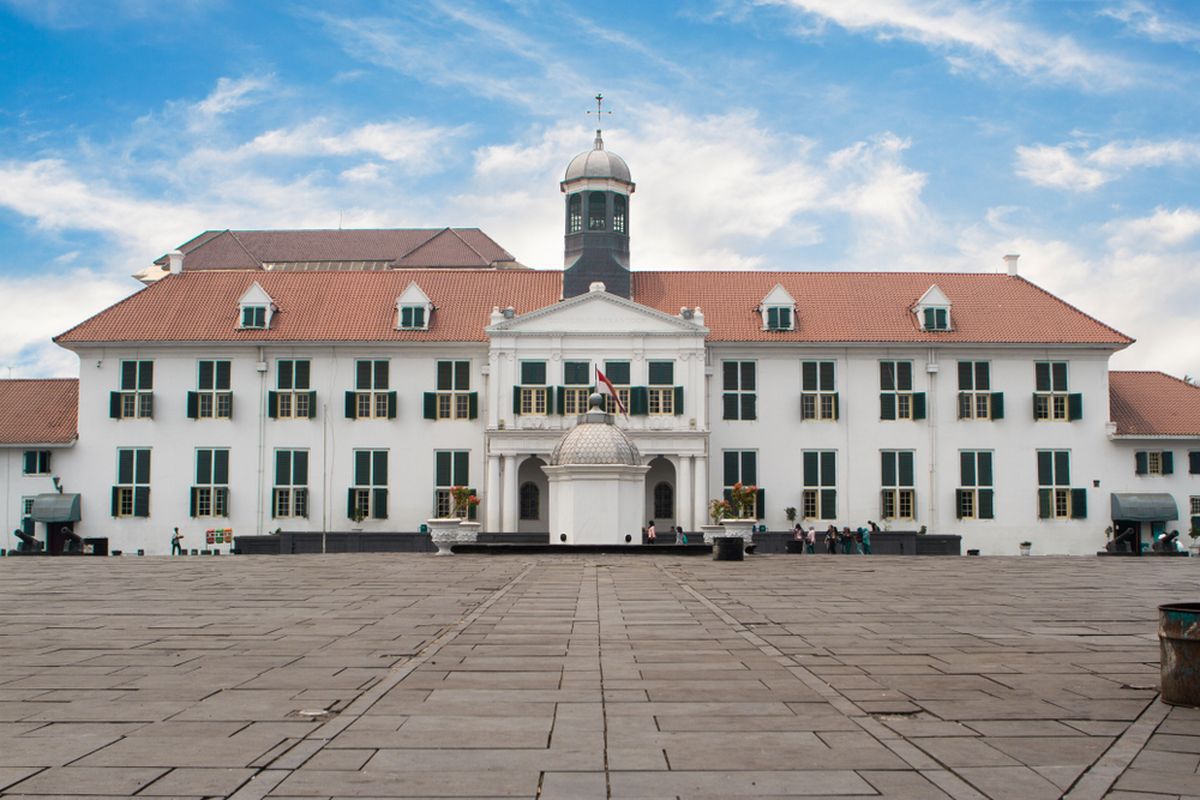
image source : kompas
Batavia was designated as “The Jewel of Asia” and “The Queen of the East” during its 16th-century magnificence. Vessels laden with rare and exotic commodities from around the globe were docked in Sunda Kelapa harbor, delivering spices, pepper, tea, coffee, pottery, textiles, and additional items from throughout the Indonesian archipelago. Tin, copper, and spices were amassed in the warehouses. The funds in the Dutch Treasury were directly attributable to the lucrative trade in Batavia.
The Stadthuis, featuring a vast front plaza, functioned as the administrative center of the VOC Dutch East India Company. The Court of Justice, financial institutions, and other prominent edifices around it.
The Dutch constructed a castle, city wall, and canals on the west bank of the Ciliwung River, facilitating the further expansion of the city. Chinatown and the dwellings of the indigenous population were situated beyond this wall. Certain regions of North and West Jakarta currently constitute this 1.3-square-kilometer area referred to as Old Batavia.
In 1526, Prince Fatahillah of Banten assaulted Sunda Kelapa, a port in the West Javanese kingdom of Pajajaran, and subsequently renamed the town Jayakarta, signifying “victory city,” on 22 June 1527. This date remains the basis for Jakarta.
Nonetheless, the colony was obliterated in 1619 by Dutch Governor Jan Pieterszoon Coen. The location was then utilized to establish the new town of Batavia, named after the Batavians, the ancestors of the Dutch.
The government has designated Old Batavia as a conservation area and is planning to develop the entire neighborhood into a tourism destination. A significant number of the historical edifices remain preserved today.
Sunda Kelapa Harbour currently serves as an inter-island port where Bugis phinisi schooners are commonly docked. The old warehouses, currently serving as a marine museum, are nearly complete. This museum exhibits reconstructions of several archipelago vessels, including those historically owned by the Dutch.
The Museum Fatahillah, situated in the center of Old Batavia, is a former municipal building that currently exhibits Jakarta’s extensive history. The square is referred to as Fatahillah Square. The Fatahillah Museum is characterized by classical Baroque design, with a central structure flanked by two wings, along with an ancillary building that contains offices, a courtroom, and an underground prison. In these harrowing dungeons, prisoners and slaves were restrained with heavy iron balls.
Notable paintings by expressionist Affandi and romantic master Raden Saleh are shown at the Fine Art and Ceramic Museum, previously the Court of Justice, situated in the square. Ceramics from several locations of Asia are also exhibited. Other museums housing banking-related items comprise the Wayang Museum, Bank Indonesia Museum, and Bank Mandiri Museum.
Nearby attractions include the Sion Protestant Church, in continuous operation since its establishment in 1695; the Pasar Ikan, or fish market; the Kota Intan Drawbridge, reminiscent of Dutch canals and bridges; and the historic Jakarta Kota Station, still operational today.
Café Batavia currently offers authentic Dutch cuisine, pastries, coffee, and tea in a serene retro environment featuring high ceilings, large windows, ceiling fans, and wooden beams.
- National Museum of Indonesia

image source : trip advisor
The National Museum, situated on Medan Merdeka Barat, is a source of pride for Jakarta, offering visitors an overview of Indonesia’s extensive cultural heritage from prehistoric times to the present. The substantially expanded museum contains an extensive collection of 109,342 pieces encompassing Indonesia’s Prehistory, Archaeology, Ethnography, Numismatics-Heraldic, Geography, and Historical Relics.
These are statues and stone inscriptions found at various sites across the archipelago, dating from the first century AD, together with a comprehensive collection of batik cloths and woven textiles created over the years on the numerous islands. On the top floor, one may view the collection of gold and silver decorations and jewellery formerly owned by the rajahs and sultans of the archipelago.
Officially inaugurated in 1868, the Museum became well known as Gedung Gajah (The House of Elephant) or Gedung Arca (The House of Statues). It was designated Gedung Gajah because to the bronze elephant monument in the front yard, a tribute from King Chulalongkorn of Thailand in 1871. It was also referred to as Gedung Arca due to the extensive array of statues from various times exhibited here. In 1979, the institution was formally designated as the Museum Nasional or the National Museum. The Museum serves as a hub for research and study of national and cultural heritage, while also functioning as an educational, cultural, and recreational information centre.
- Taman Mini
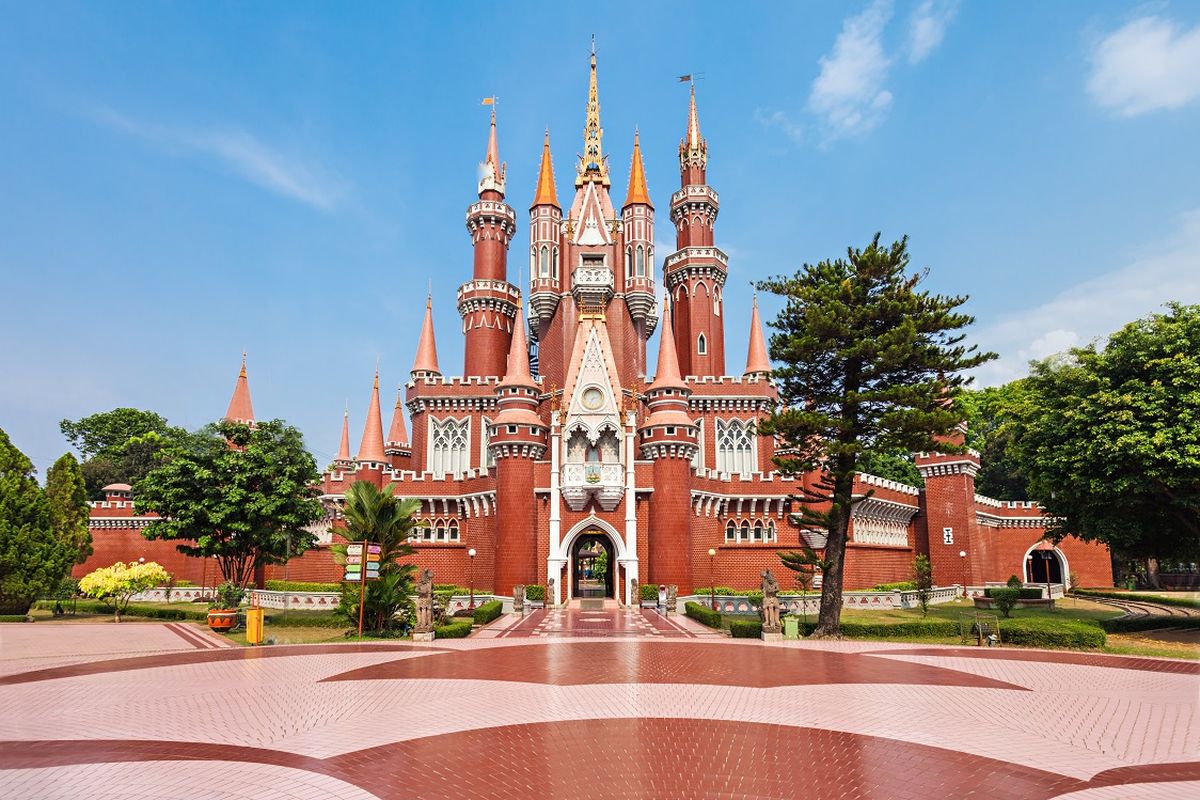
image source : kompas
Taman Mini, situated in East Jakarta, features 26 distinctive copies of traditional chieftain houses from various regions of the Indonesian archipelago, including Aceh, Kalimantan, Sulawesi, Java, and Papua. These pavilions exhibit the history, arts, crafts, and traditions of each province. Taman Mini, designed for educational and familial enjoyment, features extensive recreational spaces, several flora and fauna parks, diverse museums, performing arts theaters, an IMAX theater, and lodging amenities.
Visitors may quickly observe the remarkable diversity and comprehensive spectrum of regional architecture throughout the Indonesian archipelago, with each pavilion showcasing at least three representative examples of each regional style. “Teater Tanah Airku” is the inaugural theater in Indonesia featuring cutting-edge technology. “Teater Tanah Airku” represents a fusion of traditional Indonesian and global styles. The Komodo Museum, the Asmat Museum, a Sports Museum, and a museum showcasing presents received by President Soeharto throughout his thirty-year tenure are also dedicated to exotic creatures. Nature enthusiasts can explore the orchid gardens, cacti, herbs, flower gardens, and a Birds Park.
Taman Mini was conceived by the late Ibu Tien Soeharto, the former First Lady of Indonesia. The construction of Taman Mini commenced in 1971 and was officially inaugurated on April 20, 1975. The Park’s primary aim is to preserve and promote the diverse Indonesian cultures as a means to enhance national unity and integrity, particularly among the youth. To illustrate Indonesia’s tolerance and harmonious coexistence among all religions, the several buildings of worship that remain in active use are prominently displayed in a row. Taman Mini serves as an excellent introduction to Indonesia’s diversity and cultural heritage. Taman Mini serves as an exemplary theme park for families to familiarize themselves with various regional cultures during weekends and vacations.
- Fatahillah Museum
image source : kompas
The Jakarta History Museum, commonly referred to as Fatahillah Museum, is situated in the former City Hall in the historic district of Jakarta Kota, a short distance from the port and warehouses of Sunda Kelapa. This edifice, first named the Stadhuis, served as the administrative center for the Dutch East India Company and subsequently for the Dutch Government.
Constructed in 1710 by Governor General van Riebeeck, this robust edifice conceals beneath it infamous dungeons and unsanitary water prisoners. This museum showcases the history of Jakarta from prehistoric times until the establishment of the town of Jayakarta. The collection has a reproduction of the Tugu Inscription, originating from the 5th century during the reign of King Purnawarman, which serves as evidence that the Tarumanegara kingdom’s center was situated near the contemporary harbor of Tanjung Priok. This collection illustrates the impact of diverse cultural influences on the City of Batavia, particularly from Europe, notably the Netherlands, as well as from China, India, and Indonesia itself.
To enhance vibrancy and engagement at the Old Batavia square, the Jakarta Government has now instituted regular events featuring local communities and their cultural expressions. On Sundays, performances feature the Zapin dance, which amalgamates Betawi and Middle Eastern influences, the Barongsai Chinese lion dance, Portuguese-influenced keroncong music, traditional Betawi Tanjidor music, batik fashion shows, vintage car parades, culinary offerings, souvenirs, and fireworks.
- Istiqlal Mosque Jakarta

image source : masjid nusantara
The Istiqlal Mosque was conceived in 1954 by Frederich Silaban, a Christian architect hailing from North Sumatra. The construction of the mosque required 17 years. The building, overseen directly by President Sukarno, was executed during his government.
The concept for establishing a national mosque was conceived by Muslim leader KH Wahid Hashim and implemented by Cokro Aminoto, the then minister for religious affairs. The term Istiqlal is derived from Arabic, signifying “Independence.” The name serves as a reminder of Indonesia’s quest for national independence, and the Istiqlal was constructed to commemorate it.
The Istiqlal Mosque in Jakarta, inaugurated to the public by Indonesia’s inaugural President, Soekarno, on 22 February 1978, is the largest mosque in Southeast Asia in terms of both structure and capacity, accommodating up to 120,000 worshippers. Numerous Islamic festivities in Indonesia, like the Ied prayer, are additionally transmitted from this mosque.
The Istiqlal Mosque, a notable edifice enhancing Central Jakarta’s skyline, captivates with its vastness and modern architecture. The mosque’s structure encompasses over nine hectares (22 acres) and consists of five storeys in total. A significant portion of the structure is adorned with marble sourced from East Java.
The mosque features a spacious rectangular prayer hall, crowned by a dome with a diameter of 45 meters, which is upheld by 12 cylindrical columns and includes four tiers of balconies. The interior is predominantly understated yet embodies the mosque’s opulence. Unsurprisingly, the majority of congregants who attend prayers there allocate time to capture photographs of both the interior and exterior of the mosque, as a means of appreciating the architectural grandeur of the structure.
The mosque’s principal prayer hall will inspire admiration for its beauty. The main prayer room of Istiqlal Mosque is encircled by four stories of balconies. When seeking the mihrab, a recess that indicates the mosque’s nearest location to Mecca. The Arabic calligraphies depicting the names of Allah and Muhammad enhance the grandeur of the main prayer hall.
A series of arches extending from the center of the hall lead to an outdoor courtyard. Observe the towering minaret, which broadcasts the call to prayer daily. A fountain and pool are situated beyond the southern corner of the courtyard. The fountain dispenses water during significant Islamic rituals and festivities.
- Cathedral Church
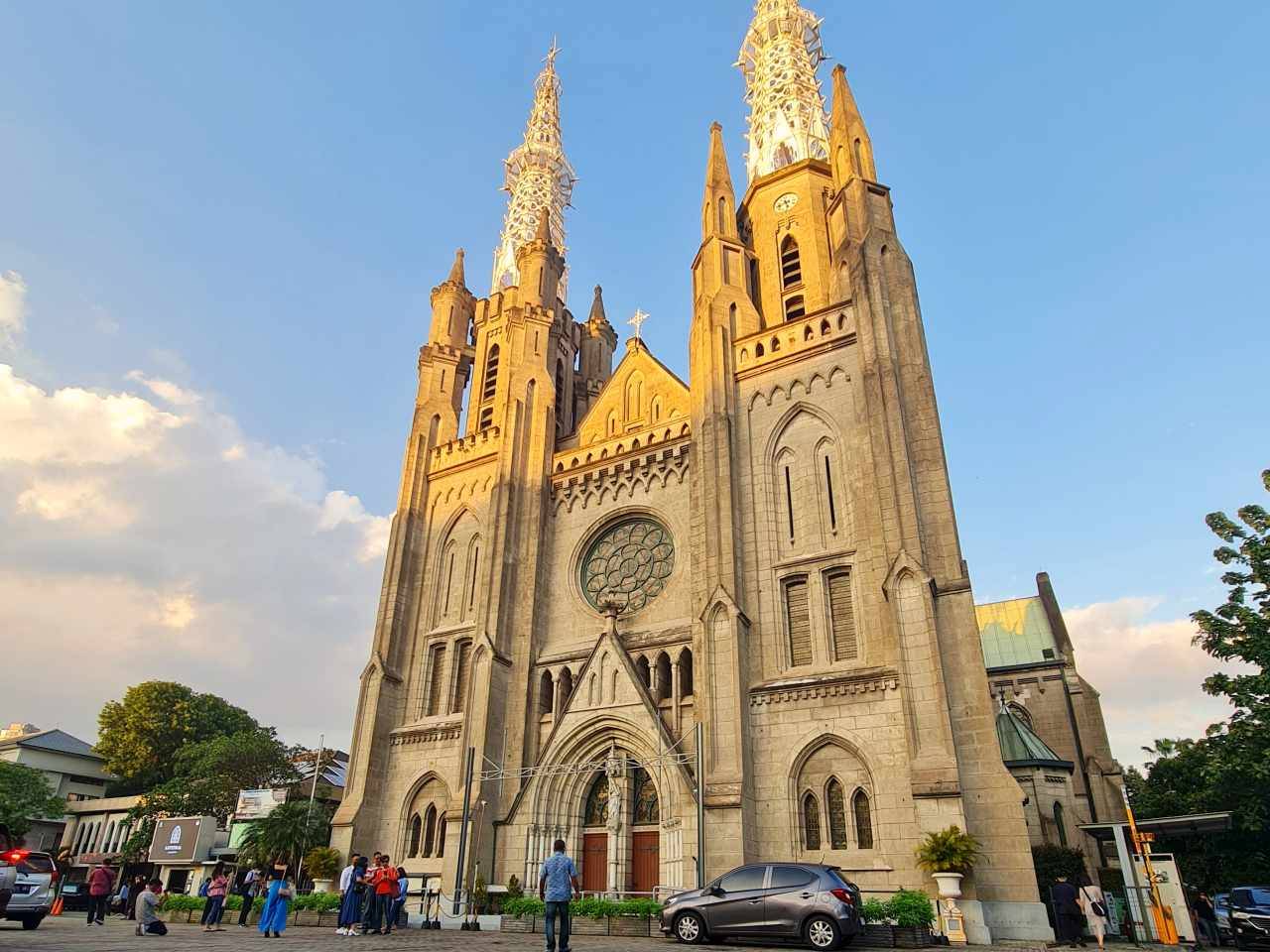
image source : ide trips
On the north corner of Lapangan Banteng, also known as Banteng Square, which was known as Waterlooplein, or Waterloo Square, in the heart of Jakarta during the Dutch colonial era, is the neo-gothic Roman Catholic Cathedral of Jakarta. Currently, the Cathedral is situated directly opposite Jakarta’s largest mosque, the Istiqlal Mosque. Their closeness is not coincidental. Soekarno, Indonesia’s inaugural president, deliberately selected the mosque’s location to represent the nation’s philosophy of unity in variety, wherein all religions may coexist peacefully and harmoniously.
Currently, both institutions persist in their collaboration, particularly to facilitate automobile parking during religious holidays. The mosque’s parking lot is utilized by the church congregation during Easter and Christmas midnight mass, while during Eid prayers, parking is extended to the Cathedral’s parking facilities.
The statue of the Sacred Heart of Jesus is situated opposite the church’s parking area.
This neo-gothic cathedral was consecrated in 1901, having been reconstructed on the site of the former cathedral, which was erected in 1829 but collapsed in 1890.
The Dutch, being Protestants, obstructed the proliferation of the Catholic faith in the East Indies, resulting in the church’s devastation. Only after Napoleon Bonaparte’s conquest of Europe and the installation of his brother Lodewijk (Louis Napoleon) on the Dutch throne was Catholicism permitted to be disseminated in the archipelago once more.
Jakarta’s Cathedral is devoted to the Virgin Mary and is formally named Gereja Santa Maria Pelindung Diangkat ke Surga, translating to the Church of Our Lady of Assumption. A statue of Our Lady Mary is positioned at the front portal, oriented westward, with an inscription above the portal stating: “Beatam Me Dicentes omnes Generationes,” which translates to: All generations shall declare me blessed. Despite its stone-like look, akin to neo-Gothic buildings in Europe, the cathedral is built from robust red brick, which is coated with plaster and adorned with patterns to simulate natural stone masonry.
The robust walls are constructed to support the teak beams that constitute the roof. The three spires consist of iron frameworks. These materials were utilized instead of stone due to their comparatively lower weight than stone construction. Three wrought iron spires rise above the church, with the two tallest at 60 meters and the middle spire at 45 meters.
Upon entering the church, one observes that the cathedral is architecturally configured in the shape of a cross. The center aisle measures 60 meters in length, with an additional 10 meters in front of the altars, extending 5 meters on either side. Three altars exist. To the left is the Altar of Saint Mary, erected in 1915, and to the right is the Altar of Saint Joseph, completed in 1922. The center altar, tabernacle, and gold cross were reportedly crafted in the Netherlands during the 19th century and placed in 1956. The church’s walls are adorned with murals depicting the Stations of the Cross when congregations pause to reflect on the sufferings of Jesus Christ from his crucifixion to his resurrection before each Easter.
On the southern side stands the statue of Pieta, depicting Mother Mary cradling Jesus Christ on her lap following his crucifixion. A high, ornate pulpit is positioned on the central right, including a shell-shaped structure above for acoustic enhancement. The structure comprises two levels. The upper floor, formerly designated for the choir, has been repurposed into a museum due to structural concerns regarding its capacity to support large gatherings. This museum houses artifacts related to rituals from the era of the Dutch East Indies, as well as the history of Catholicism’s dissemination in Indonesia.
The Cathedral remains in constant use today. During Easter and Christmas, when congregations exceed capacity, tents are erected in the parking lot to accommodate the multitude, enabling them to participate in mass via television monitors.
- Dufan
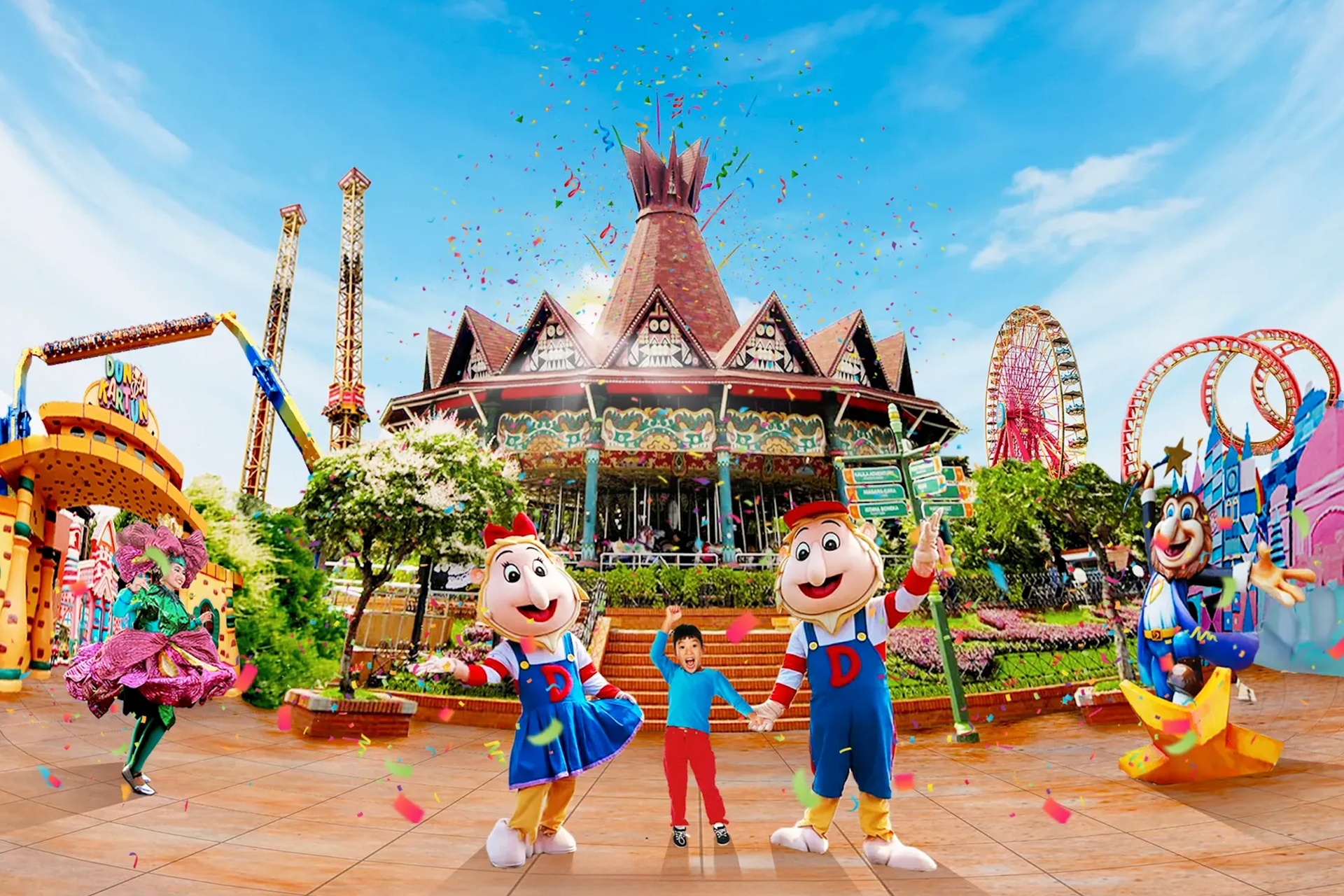
image source : tiket
Dufan, Jakarta’s theme park, features over 40 rides and attractions. It is situated in North Jakarta, overlooking the Java Sea. It was inaugurated on 29 August 1985. The theme park comprises eight regions: Jakarta, Indonesia, Asia, Africa, America, Europe, and the Fantasi Hikayat zone, which showcases architecture from Ancient Greece and Ancient Egypt.
- Glodok
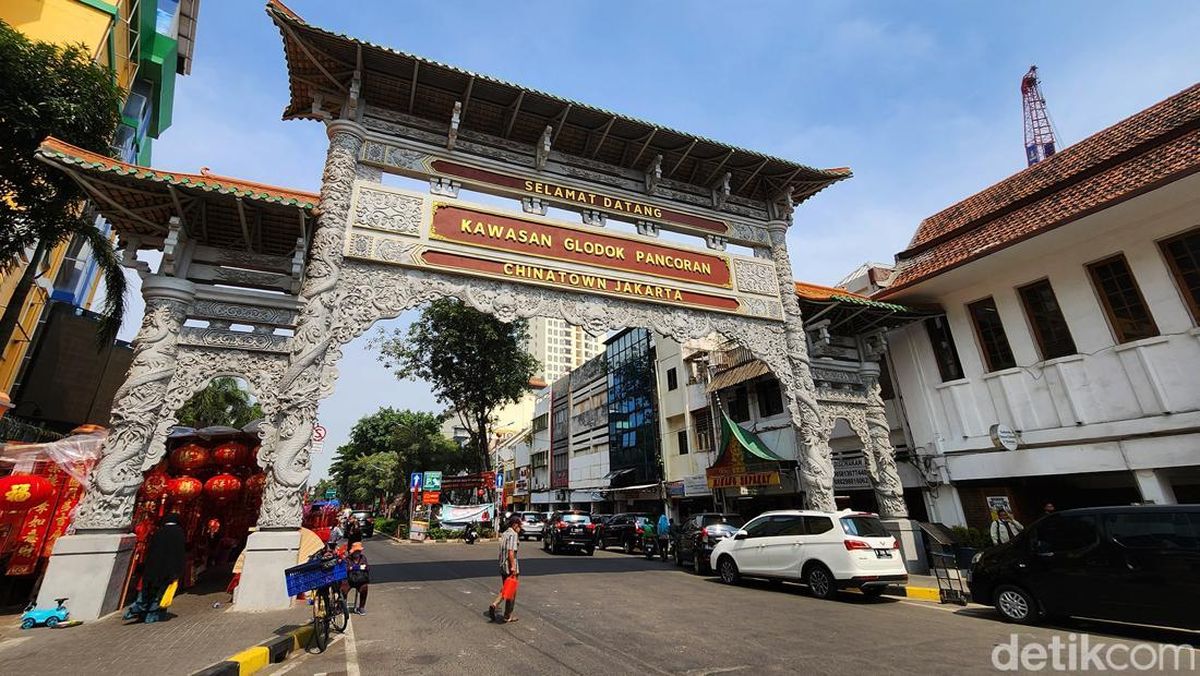
image source : detik
Chinatown has long been recognized as an important part of every city, a center of commerce, and an economic powerhouse. Glodok, located in Jakarta, Indonesia’s capital city, is often hailed as one of the biggest Chinatown regions in the world. It is part of the Taman Sari neighborhood in West Jakarta. Known as Chinatown or Pecinan during the Dutch Colonial Era, this area of The Old Batavia City is home to several people of Chinese heritage. These days, most people associate Glodok with Jakarta’s electronic trade center.
Tourists can absorb the area’s storied past as they meander around the streets of this city inside a city. You may trace your steps through a maze of old temples, traditional Chinese houses, and other landmarks.As you travel, take notes, and do some shopping. Originally from the Sundanese term “Golodog,” meaning “the entrance to a house,” Glodok was named after the old Sunda Kingdom’s gateway, Sunda Kelapa (now Jakarta).
Throughout Dutch colonization, the city saw an influx of thousands of people from parts of what is now Indonesia drawn by the commercial opportunities it offered. The massive influx of Chinese artisans, sugar mill workers, and shopkeepers was also a part of this. Locals and the Dutch colonial administration both started to feel intimidated by the fast-increasing Chinese population.
Unrest among Chinese sugar merchants ensued in 1720 when Dutch lords established a uniform price for sugar after a 50% drop in world sugar prices driven by greater competition and shipment from the West Indies. A hundred and fifty Chinese people, mostly involved in the sugar trade, rebelled against the Dutch on the 7th of October 1740, and fifty of their soldiers were killed. Geger Pacinan, a tragic event, occurred on October 9, 1740. Dutch troops opened fire on Chinese residences, killing over 10,000 ethnic Chinese, because to rumors of an additional rebellion. The surviving Chinese people moved out of Batavia the next year and settled in what is now Glodok, an area beyond the city walls.
- National Monument Jakarta
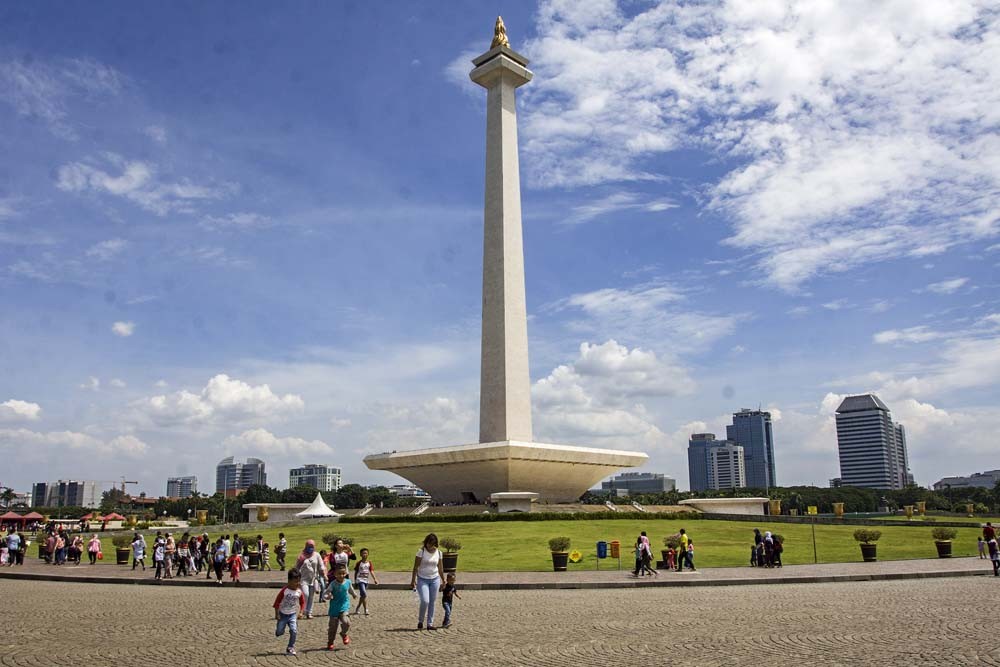
image source : the jakarta post
The major Sudirman-Thamrin roadways in Jakarta converge at Merdeka Square, where the National Monument (referred to as Monas or Monumen Nasional) is situated at the center, containing the inaugural red-and-white flag raised after the Proclamation of Independence on 17 August 1945. The banner has become threadbare; so, during Independence Day events, the original flag is shown just to accompany the replica flag flown in front of the Merdeka Palace. The 137-meter tall National Monument is obelisk-shaped and features a 14.5-meter bronze flame adorned with 32 kg of gold leaf.
Inside the pedestal is a museum showcasing a diorama chronicling Indonesia’s struggle for independence, along with the actual text of the Proclamation of Independence. An elevator transports tourists to the observation deck at the base of the flame, offering a panoramic view over Jakarta. The area encircling the Monument has been transformed into a park featuring a musical fountain, which the Jakarta populace frequents on Sundays for athletic and recreational activities. Deer traverse the shaded areas of the park’s trees.
Merdeka Square serves as the nucleus of significant governmental edifices. During the Dutch colonial era, this location served as the governmental center, referred to as Koningsplein or the King’s Square. The northern sector is characterized by the Merdeka Palace, formerly the residence of the Dutch Governor Generals, which currently accommodates the office of the President and the Cabinet. To the south lies the office of Indonesia’s Vice President, Jakarta’s Governor, and the provincial parliament building, along with the American Embassy. To the west are the National Museum, the Constitutional Court, the Ministry of Culture and Tourism, and the Indosat building, Indonesia’s inaugural international telecommunications company.
- Ancol
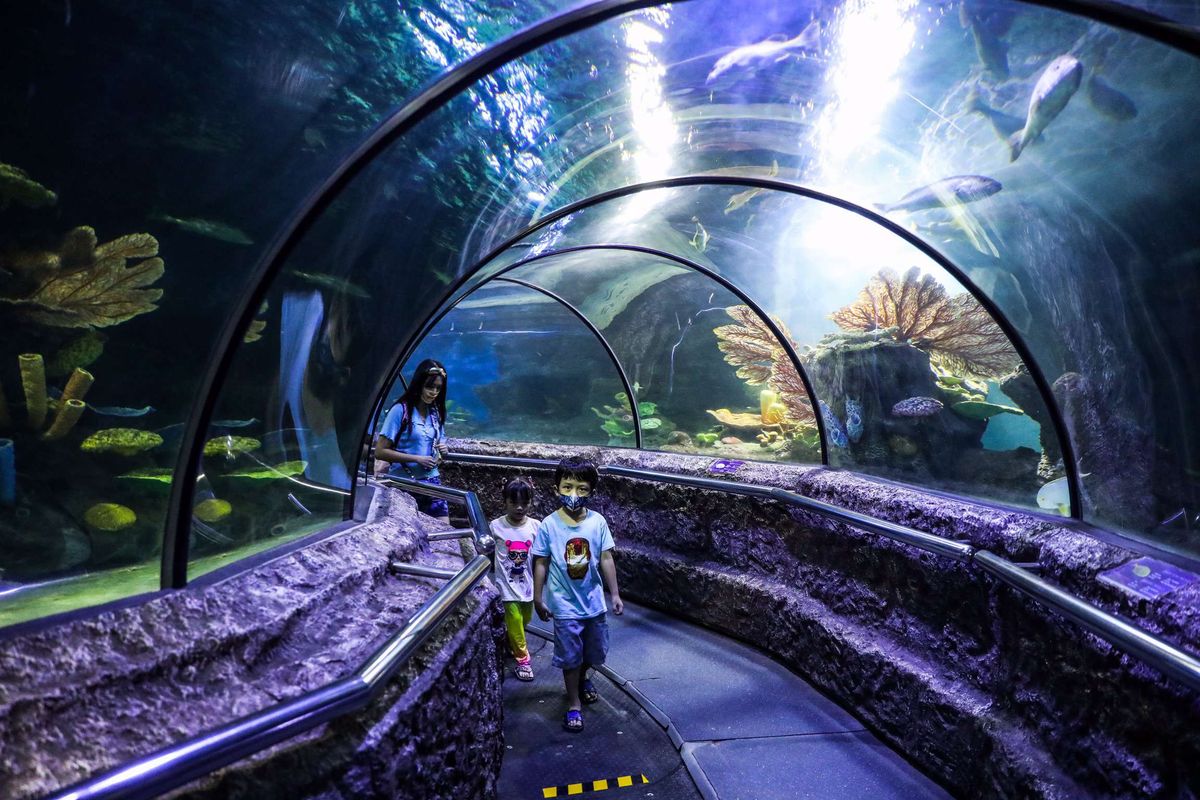
image source : kompas
Ancol Dreamland is the largest and most renowned recreational park in Jakarta. Ancol Dreamland features a diverse array of attractions, including a large oceanarium named Seaworld, a water park with artificial waves, a lagoon for fishing and boating, a convention hall, and hotels. Dunia Fantasi (Fantasy World) is a theme park featuring exhilarating attractions, including the Tornado and Hysteria rides.The ‘Pasar Seni’ is an art center featuring a diverse array of Indonesian handicrafts, paintings, and souvenirs for sale. At this art and handicraft market, attendees observe Indonesian artists crafting their masterpieces. Numerous artists from all over the nation gather here to showcase their creations, rendering this a captivating destination for tourists and art enthusiasts. A portrait of yourself can also be commissioned. Exhibits feature both traditional and contemporary art and crafts, encompassing paintings, sculptures, traditional Indonesian wayang kulit (leather puppets), gemstone jewelry, and various other artistic creations.
Pantai Carnaval features eateries offering local and international cuisine, with several specializing in seafood. It is worthwhile to sample “Es Kelapa Muda,” or Young Coconut Ice drink. In the Ancol Jakarta Bay City region, multiple hotels are available, including Raddin Hotel, Wisata Hotel, Mercure Hotel, and Putri Duyung Cottages, each offering a range of pricing and amenities.
Marina Ancol is a designated harbor for yachts, motorboats, and sailboats, serving as the departure point to the Kepulauan Seribu or Thousand Islands resorts. This site is also suitable for windsurfing and other aquatic activities. Beach amenities for the marine or lagoon region are abundantly available: water bicycles, canoes, sailboats, fishing equipment, and various others. Numerous stalls provide beverages and food along the beach.