Yogyakarta
The epicenter of civilization on Java is Yogyakarta, which is accompanied by its twin city, Surakarta (Solo). The city was the center of power that gave rise to the magnificent temples of Borobudur and Prambanan in the 8th and 9th centuries, as well as the new, potent Mataram kingdom in the 16th and 17th centuries.
The slogan “Jogja The Never-ending Asia” describes Yogyakarta, which was renowned for its boundless allure. It is also known as “Jogja Istimewa” today, a motto elucidating its unique values.
This city is a prominent cultural hub in Indonesia. From exploring the living museum of The Kraton or The Keraton (Sultan’s Palace) to relaxing at the renowned Alun Alun, to witnessing the creation of stunning jewelry by silversmiths at Kotagede, and perhaps even trying an indulgence at Malioboro Road.
In this relatively small yet bustling city, there are numerous additional opportunities to avoid boredom, such as chasing the dawn at renowned temples such as Prambanan and Borobudur in the neighboring town of Magelang.
This artistic city offers the opportunity to witness each of the five marvels. Begin by experiencing the natural marvels by visiting picturesque beaches and photogenic landscapes. Parangtritis, Indrayanti, Pok Tunggal, Siung, Krakal, and Jogan are among the most renowned beaches in the area.
Puncak Becici, Pinus Pengger, and Jurang Tembelan are just a few of the numerous thrilling destinations in Yogyakarta that offer a return to nature experience.
Be sure to sample the Gudeg, a unique preparation of a traditional Javanese recipe that is emblematic of this city, before experiencing its culinary delights. The Bakpia is a traditional snack that is popular as a souvenir due to its numerous enticing varieties. For a beverage, consider the Jamu, a natural herb blend beverage that has been used for centuries as a natural remedy.
Batik is a national treasure that is derived from the Javanese words “amba” and “titik,” which both mean “to write the dots.” It is a form of fabric decoration that involves the use of wax and the dyeing process. A brilliant white basic is typically used to create the signature batik pattern of Yogyakarta. The Parang Kusumo, Kawung, and Truntum are among the motifs that were developed with a unique philosophy that is evident in each dot.
Batik Tulis, Batik Cap, Batik Print, and the combined outcome of the techniques are all viable options. The costliest are the Batik Tulis, which are ornaments that are entirely hand-painted. It will become even more expensive if it is crafted from precious silk fabric. The production of a high-quality Batik Tulis can vary in duration, from a single day to a meticulous process that spans several months, depending on the design’s complexity and size.
Wayang is also a remarkable art heritage that is recognized in Yogyakarta. There are the Wayang Kulit, or leather puppets, which are performed in a shadow puppet performance by the dalang or puppet master through a screen illuminated by lights. The life-size performances of Wayang Orang, which are presented by men and women in elaborate traditional costumes, depict the same philosophical messages from ancient stories.
By visiting the tourism villages in Yogyakarta, you can uncover the marvels of recreation. Tembi, Pentingsari, and Nglanggeran are three of the locations from which to begin. Immerse yourself in the genuine daily routine of the locals and acquire new skills, including the ability to play the gamelan, weave janur, and perform a traditional Javanese dance.
Yogyakarta is also awash with adventure tourism opportunities. Starting with a thrilling Jeep journey, exploring Mount Merapi National Park, and hiking Mount Nglanggeran, an ancient volcano situated in a picturesque village.
Siung shore offers rock climbing opportunities, while Goa Pindul is a popular destination for cave tubing. For those seeking an underrated, high-adrenaline experience, Goa Jomblang is the ideal destination. Goa Jomblang, an immense, 80-meter-deep vertical cave situated in Jetis Wetan Village, is naturally adorned with karst formations and plants, including ferns, quartz stones, stalagmites, and stalactites. Additionally, there is an underground river that is swiftly streaming. This cave is accessible to both novices and experts, as a cave guide will provide them with guidance.
Yogyakarta is a city that offers a plethora of attractions for visitors to experience. Yogyakarta is the second most visited destination in Indonesia, following Bali, due to the aforementioned and numerous additional attractions.
1. Prambanan Temple

image source : Wikipedia
Situated close to the Buddhist Borobudur temple, the closeness of the two temples indicates that in Java, Buddhism and Hinduism coexisted harmoniously. Prambanan stands as a stunning representation and a symbol of Indonesia’s rich cultural heritage. The temples at Prambanan were constructed in the 9th century and are referred to locally as Roro Jonggrang, deriving from the legend of the ‘slender virgin’.
The largest temple is devoted to Shiva – the destroyer, while the two smaller temples flanking it are dedicated to Brahma, the creator, and Vishnu, the sustainer. The tallest temple of Prambanan reaches an impressive height of 47 meters. The peak stands out prominently from a distance, towering above the remnants of the other temples.
After centuries of neglect, the Prambanan temple was rediscovered by CA Lons, a Dutchman, in 1733. Since then, this temple has undergone revitalization and is now considered the most beautiful and graceful Hindu temple in Indonesia. The magnificence, intricacy, and cohesive architectural design of Prambanan render it an exceptionally remarkable edifice. Prambanan, recognized for its distinct cultural and architectural significance, was designated a World Heritage site by UNESCO in 1991.
Visitors to Prambanan explore the temples on foot. This is an excellent way to appreciate the vibrant landscape and observe the intricate architecture and design of the temples up close.
The temple compound spans an area of 39.8 hectares. The main yard features three primary temples, three Wahana temples, two Apit temples, and eight Patok temples, all enclosed by fences. In the second yard, there exist an additional 224 Perwara temples. Exploring this area and taking in the detailed stonework will surely occupy your time throughout the day!
In contrast to the temples at Angkor Wat, the temples of Prambanan offer a more straightforward navigation experience and are more accommodating for tourists. The vicinity of Prambanan features a well-maintained park and shops offering a variety of tourist souvenirs. Although it isn’t located in a secluded, rustic area, the magnificence of the temple will swiftly make you overlook your environment. You will be taken back to a bygone era where tradition and cultural practices permeated every aspect of existence.
2. Kalasan Temple

source image : tripadvisor
Kalasan Temple is regarded as the oldest Buddhist temple in Central Java and Yogyakarta, even preceding the magnificent Borobudur Temple. Situated along the southern main road connecting the cities of Yogyakarta and Solo, it is roughly 2 Km from the Prambanan Temple complex. The temple is situated on a rectangular base measuring 45 by 45 meters.
Every one of the four primary cardinal points features stairs and gates embellished with Kala-Makara, along with rooms that measure 3.5 square meters. No statue is present in the smaller room facing north, west, and south; however, the lotus pedestals indicate that the rooms likely once housed statues of bodhisattvas. The temple features elaborate decorations of Buddhist figures, including the Bodhisattva and Gana.
The Kalasan inscription discovered near the temple reveals that it was finished in the Saka year 700, corresponding to 778 AD. Composed in Sanskrit utilizing the Pranagari script. The temple’s octagon-shaped canopy is a noteworthy feature. It is adorned with carved images of the Tathagatas/Buddha, each of whom is flanked by a pair of bodhisattvas in bas-relief, and faces the four cardinal points.
The Kalasan temple is situated in the archaeologically abundant Prambanan valley. Located just a few hundred meters northeast of Kalasan, the Sari Temple (or Candi Sari) is likely the monastery referenced in the Kalasan inscription.
3. Borobudur Temple

Source image : wikipedia
Borobudur, also rendered as Barabudur (Indonesian: Candi Borobudur), is a 9th-century Mahayana Buddhist temple located in Magelang Regency, Central Java, Indonesia, close to the city of Magelang and the village of Muntilan.
The temple is composed of nine piled platforms, six of which are square and three of which are circular, and is constructed of gray andesite-like stone. The central dome tops the temple. It was originally adorned with 504 Buddha statues and 2,672 relief panels. The central dome is encircled by 72 Buddha statues, each of which is situated within a perforated stupa.[2] The monument leads pilgrims through a comprehensive network of stairways and corridors, which are adorned with 1,460 narrative relief panels on the walls and balustrades. Borobudur boasts one of the most comprehensive collections of Buddhist reliefs in the world.
The temple was constructed during the Sailendra Dynasty and is designed following Javanese Buddhist architecture. This architecture combines the Indonesian indigenous tradition of ancestor veneration with the Buddhist concept of achieving nirvāṇa. The monument serves as a Buddhist pilgrimage site and a memorial to the Buddha. According to evidence, Borobudur was originally constructed in the 8th century and was subsequently abandoned as a result of the 14th-century decline of Hindu kingdoms in Java and the Javanese conversion to Islam. In 1814, Sir Thomas Stamford Raffles, the British governor of Java at the time, was informed of its location by native Indonesians, which precipitated a global awareness of its existence. Borobudur has been preserved through numerous restorations. The monument was designated as a UNESCO World Heritage Site in 1983, following the completion of the greatest restoration project by the Indonesian government and UNESCO.
Borobudur is the largest Buddhist temple in the world and is considered one of the major archeological sites of Southeast Asia, alongside Bagan in Myanmar and Angkor Wat in Cambodia. Borobudur continues to be a popular destination for pilgrimage, as Buddhists in Indonesia commemorate Vesak Day at the monument. Borobudur is the most frequently visited monument among Indonesia’s tourist attractions.
4. Mendut Temple

source image : wikipedia
Yogyakarta will be a thrilling destination to visit during May. You are invited to observe the grand commemoration of the Buddhist holiest day, Vesak 2561/2562, which takes place on May 11, 2017. The date is determined by the time of the Purnama Sidhi, the brightest full moon that occurs in May. The Mendut temple is one of the magnificent Buddhist temples in Central Java, Indonesia, where the procession is performed annually.
The temple, which is the oldest of the two other Buddhist sanctuaries, Borobudur and Pawon, was constructed in the 9th century. The temple, which stands at a height of 26.4 meters, was not only the focal point of Buddhist practices and rituals, but it was also considered the ideal location for meditation by the local Javanese Kejawen. The locals regard a stone-carved image of Hariti as a symbol of fecundity and motherhood, and it is a popular destination for couples who aspire to have children.
Buddha’s Day, also known as Vesak, commemorates the birth of Prince Siddharta, the Enlightenments that transformed him into the Buddha, and the passing of Gautama Buddha. Three significant events in Buddha’s life are also referred to as Tri Suci Waisak.
Thousands of individuals will gather to commemorate this sacred day by reciting mantras and engaging in meditation. The prayers will commence at Mendut temple on May 9th and will be followed by a chanting procession that will proceed to Pawon and Borobudur temple.
Additionally, a significant ritual of blessing is performed annually, using sacred water extracted from the springs of Jumprit in the Temanggung district to represent humility. Flames from Mrapen, which are the natural eternal flames in the village of Grobogan, Central Java, will also be used to ignite the Vesak torch.
Both are stored in the Mendut temple before being transported during the march procession to represent enlightenment. Additionally, on May 11, a spectacular pinnacle event will take place, during which thousands of Puja lanterns will be released into the sky after the pilgrimage. The lanterns will be unleashed from the temples of Mendut, Pawon, and Borobudur, symbolizing the enlightenment of the entire universe.
5. Sultan Palace

image source : dinas kebudayaan yogyakarta
The Palace of Yogyakarta, also known as the Kraton (also spelled keraton or karaton), is a magnificent complex that was meticulously designed to reflect the Javanese cosmos.
The construction of this sophisticated complex of pavilions was inspired by ancient beliefs regarding the interconnection between the natural, human, and divine domains. Each feature is associated with a unique symbolic significance in the Javanese worldview, which emphasizes the significance of Mount Merapi and the Indian Ocean.
The Kraton was constructed in the center, with its north-facing orientation toward the majestic Mount Merapi. The south side of the structure was constructed to face the Indian Ocean, which is regarded as the residence of Kanjeng Ratu Loro Kidul, the Queen of the South Seas and the mystical consort of the Sultan.
No other example of traditional Javanese architecture is as impressive. During the reign of Sultan Hamengku Buwono I, in 1755-1756, the primary building of The Kraton was constructed with its fundamental and original layout.
Subsequently, the heir to the throne progressively expanded adjacent pavilions. Praja Cihna is the palace’s official symbol. It illustrates critical components that emanate a philosophical significance. The central Javanese lettering is “ha” and “ba,” which is the acronym for Hamengku Buwana. Gold is a symbol of majestic magnificence, while red is a symbol of courage and vigilance to value the truth.
The palace’s front side will be a green square known as Alun-alun Lor or the north square, with Kyai Dewandaru and Kyai Wijayandaru, two enormous banyan trees, guarding its center. Alun-alun Kidul, or the south square, is situated on the opposite side of the palace’s north-south imperceptible horizontal axis.
This palace was intended to serve as more than merely a regal residence. It was constructed to serve as the centerpiece of the Sultan’s complete domain. When a sovereign passes away, the cortege will depart from the southern gate and proceed to the royal cemetery in Imogiri.
In the present day, the Kraton is a part of living history and tradition. It remains in use as the Sultan’s residence and for other significant ceremonial and cultural functions of the Yogyakarta court.
The Kraton area’s highest level is Sitihinggil, where formal ceremonies such as the coronation are conducted. The palace complex contains two Sitihinggil pavilions.
Gedung Sasana Hinggil Dwi Abad is a monument that was repurposed from the location of the army’s rehearsal site to commemorate the 200th anniversary of the Yogyakarta sultanate. Sitihinggil Lor is situated on the north side, while Sitihinggil Kidul is on the south side. Artistic performances, including music, dance, and the unique wayang kulit or leather marionette show, are available on weekends.
Alun-alun Kidul, a destination that is renowned for its festive evening ambiance and the enigmatic Masangin tradition, is situated close to this structure. This is undoubtedly one of the most distinctive local experiences to attempt, as it is purported to be an acronym for “masuk diantara beringin” or “entering between the beringins.”
If you are successful in this test, you will be deemed to possess a pure heart and will have any of your desires granted. You will be required to walk between the two sacred beringin or banyan trees. The sole catch is that you must be blindfolded in order to perform it.
After a few attempts, you can simply relax in the open square and soak up the lively atmosphere that envelops this renowned location.
The Kraton complex is divided into seven distinct zoning zones, each of which is comprised of multiple pavilions, each with a specific purpose, and is separated by gateways. Kraton Kilen, the sultan’s residence, is situated in the heart of the Kedhaton territory.
The Hamengku Buwono IX museum is one of the intriguing attractions within The Kraton. It is home to a collection of memorabilia and significant objects that belonged to the late father of the current reigning Sultan, Hamengku Buwono X, who is also the Governor of the Special Region of Yogyakarta.
Additionally, there are museums dedicated to regalia, royal carriages, and painting. Each of these exquisite regal carriages is distinguished by its unique name and intriguing historical significance. Additionally, they are employed for special events, including royal wedding ceremonies.
The Sultan’s title is not the sole hereditary position in The Kraton. Additionally, you may encounter the Abdi Dalem, who are the devoted attendants of the royal households. This virtuous devotion is an honorable pride that is transmitted from one generation to the next.
Despite the modernization of Yogyakarta, the Kraton of Yogyakarta remains revered by the local populace. Ancient tradition and mysticism continue to be significant components of The Kraton’s rituals, even though the majority of the Yogyakarta population is Muslim.
Special ceremonies are conducted periodically to cleanse the sacrosanct objects in the Royal collection. Women in traditional costumes can also be observed respectfully sprinkling water and flowers on the pillars and igniting incense to cleanse The Kraton from impure intentions and evil spirits in the afternoons after the palace is closed to visitors.
6. Taman Sari Water Castle
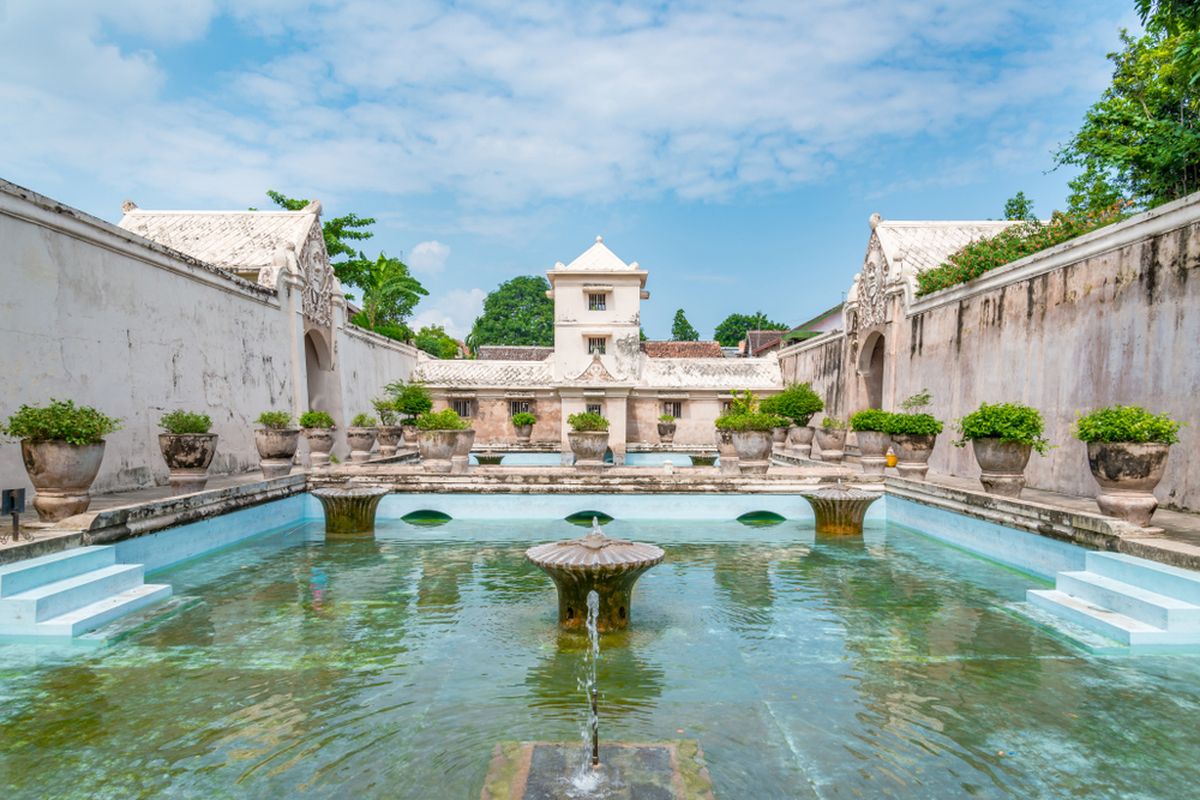
This spot, which was formerly the Sultan of Yogyakarta’s garden, is close to the Kraton. Only a handful of the original structures from Tamansari’s multi-use design remain today. Originally, it served as a sanctuary for the Sultan’s family as well as a site to work, meditate, conceal, and rest. Some of its structures are now inhabited by locals; today, visitors can only enter the mosque, the resting and bathing place, and the underground tunnels.
This one-of-a-kind royal retreat has its history and charm thanks to its blend of Eastern and Western architectural styles. Tamansari is primarily known for Umbul Pasiraman, the Sultan’s and his princesses’ bathing and resting retreat. There is a fascinating history to this location, which is why many visitors find it intriguing.
The Umbul Pasiraman was created to fulfill the Sultan’s wish to go hunting in his leisure time. With its name meaning “a place to take a bath,” the Umbul Pasiraman was built for the Princesses to relax in while the Sultan “hunted” for a wife, in contrast to the Panggung Krapyak, which was intended for deer hunting.
It is stated that the Sultan would throw a rose from the high tower on the south side of the pool to catch his “two-legged prey,” and the princess who caught the rose would become his “wife.” The Queen or her concubines would typically be the ones to catch the rose. The Sultan’s daughters and his prospective spouses might relax in one of three pools at Umbul Pasiraman: Umbul Binangun, Umbul Muncar, or Blumbang Kuras.
There is a mosque and an underground tunnel for guests to explore in addition to the Umbul Pasiraman. The tunnel, which was formerly a hideout, is now largely used by residents and is thus no longer functional. The mosque on this site is circular in design, unlike most mosques; beneath it, the Sultan would pray at Sumur Gumilang.
7. Jeep Merapi
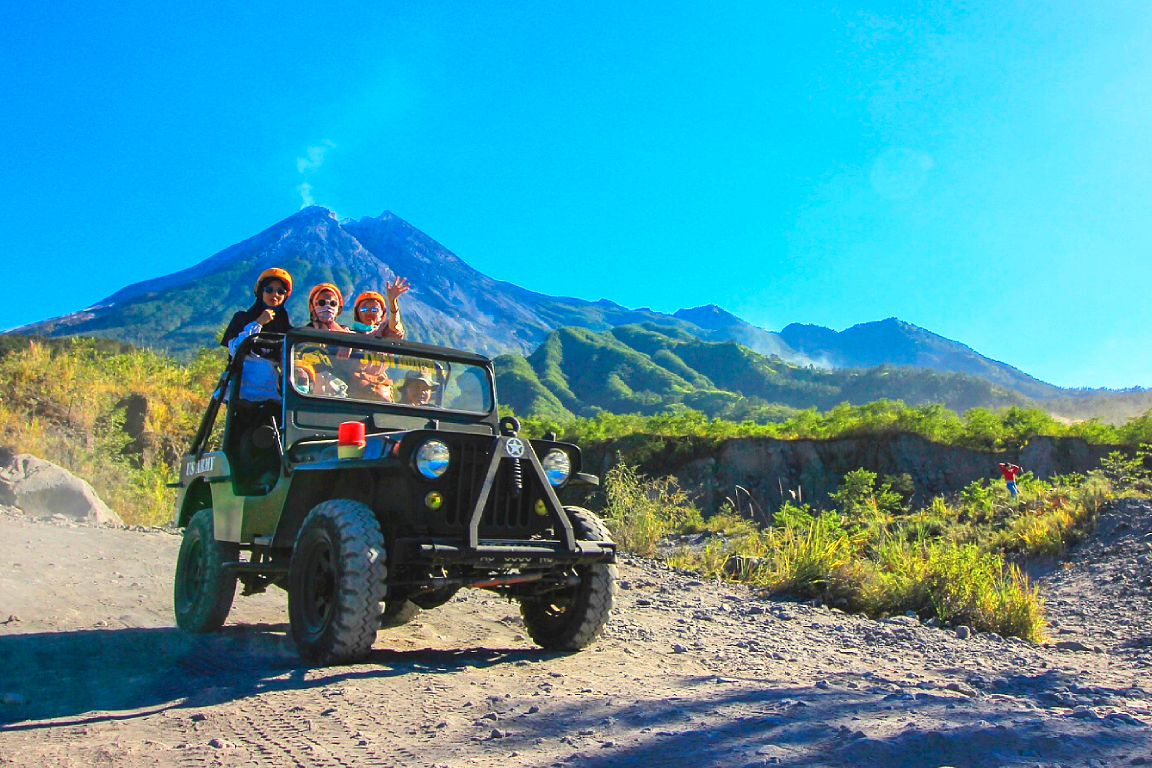 image source : tiket.com
Explorationof Merapi and the Lava Tubes
The knowledgeable drivers and specially designed double-axle jeeps make for an exciting and safe adventure. We were able to experience the thrill of this type of tour because the journey began on an adequately steep ascent. Signs indicating the presence of steep roadways filled with huge rocks can be seen on paved roads that were affected by the 2010 eruption of Merapi.
8. Malioboro
 Image source : wikipedia
Malioborois the most renowned thoroughfare in Yogyakarta. This principal thoroughfare, situated in the city’s core, formerly served as the ceremonial route for the Sultan’s passage to and from the Keraton. The name Malioboro is believed to originate from British Governor Marlborough during the period of British sovereignty over the archipelago from 1811 to 1816.
Malioboro is filled with businesses selling curiosities and street sellers providing souvenirs at reasonable costs, ensuring that you will discover something of interest on this street. If you seek batik as a keepsake, Malioboro is the ideal destination. Batik can be utilized to create bags, tablecloths, bed linens, pillowcases, curtains, and numerous other items.
Opposite the road lies the Vredenburg fort, formerly the barracks for Dutch soldiers, today serving as a hub for arts and painting exhibitions. Beringharjo market, Yogyakarta’s bustling primary market, is located on the same side of the road. This street features Yogyakarta’s oldest hotel, the Garuda Hotel, constructed in Dutch colonial design.
During the night, the street becomes vibrant as vendors set up tents offering a variety of local dishes. You must sit cross-legged in the tents, which the locals call “lesehan”. Savor your lunch while experiencing the lively nightlife of Malioboro. It is an unforgettable experience.
9. Kota Gede
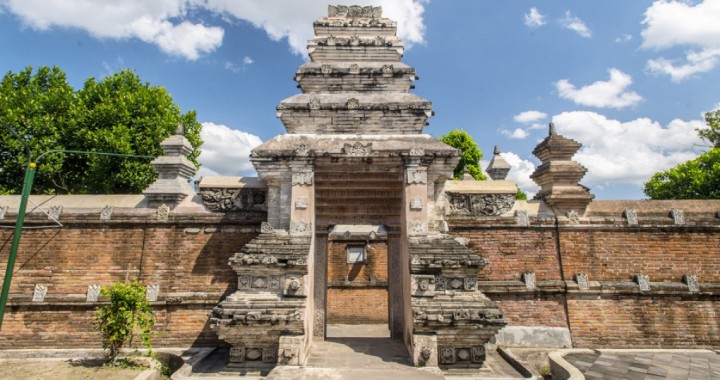
image source : dinas kebudayaan yogyakarta
Oneof Yogyakarta’s suburbs is Kota Gede. Houses with mosaic tiles that were originally owned by members of the nobility and merchants for the royal family border the town’s winding, narrow lanes, which were once home to traditional silversmith shops. Come to Kota Gede and have a stroll around. The silver industry in Yogyakarta has brought this precinct widespread fame.
Anyone interested in seeing the incredible process by which silversmiths can fashion raw metal into an exquisite piece of jewelry can drop by any one of several workshops in the area. Embossment and the contrast between black and white in Yogyakarta silver are its defining features. Those crafted from sterling silver are the finest. Stunning silver tea sets, necklaces, bracelets, and brooches adorned with delicate filigree are all creations of Kota Gede. Come here to peruse (or perhaps purchase) some exquisitely produced silver if you’re a shopper.
10. Wayang Kulit
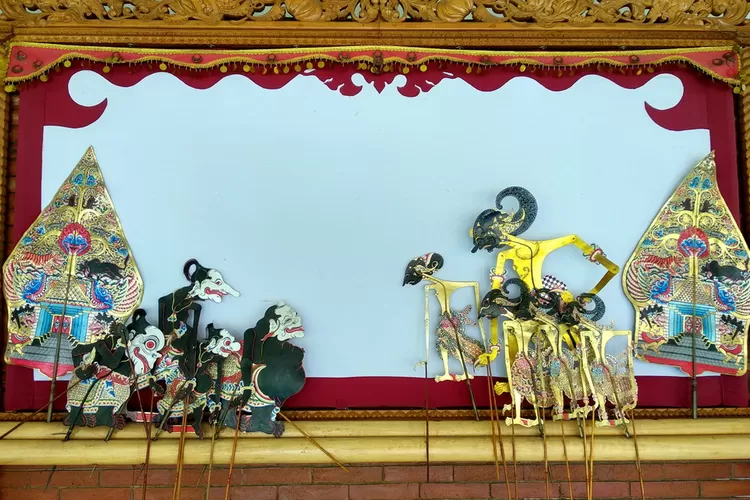
image source : umsu.ac.id
Despite the fact that the audience observes the narrative through the silhouettes of figures projected from behind the screen, the characters of the play are not merely puppets. Rather, they are meticulously carved and cut from untanned leather, which is then meticulously painted. In Indonesia, the performance is referred to as Wayang Kulit, or the Wayang Leather puppet performance, to differentiate it from other types of wayang puppets, such as those constructed of wood.
The Wayang stories are typically derived from episodes of the Hindu classic sagas of the Mahabharata and the Ramayana. The stories are not only engaging, but they also impart profound philosophical ideas and instill noble values. Wayang Kulit performances are consistently present at folk festivities and significant events, such as weddings, births, and other celebrations, and they last the entire night, accompanied by the extraordinary live music of the Javanese gamelan percussion orchestra. The specific narrative and messages that are conveyed are typically pertinent to the event.
The protagonists in Wayang stories encounter moral and ethical quandaries as they traverse the stages of life, love, and war. The stories are primarily about the conflict between good and evil; however, they also explore the existential struggle between right and wrong. They pertain to the pursuit of a virtuous, noble existence and the pursuit of purpose in life.
The Wayang-themed activities foster further investigation of moral life objectives, integrity, a sense of responsibility, perseverance, and compassion for others. For instance, the production of wayang puppets (menatah) would necessitate perseverance and motivation to enhance one’s skills and abilities. The puppets (mendalang) are also used to convey a moral story that is intended to enlighten as well as entertain.
11. Gudeg
 Image source : wikipedia
Gudegis primarily composed of immature, unripe jackfruit, which is locally referred to as gori. The immature jackfruits are shredded and boiled with palm sugar and coconut milk over low heat for several hours. It is most flavorful when prepared in an earthen vessel over a wooden or charcoal fire. The dish’s reddish-brown hue is achieved by incorporating garlic, shallot, candlenut, coriander seed, galangal, bay leaves, and teak leaves into the mixture. Gudeg is frequently referred to as the “young jack fruit sweet stew” due to its saccharine flavor.
Gudeg is the quintessential illustration of Javanese slow and meticulous cookery, in stark contrast to the “fast food” of the West. The preparation of this traditional jackfruit stew can be both laborious and taxing. The majority of the process is time-consuming and necessitates meticulous attention to detail. Consequently, the process of constructing the ideal Gudeg can consume nearly an entire day. In a sense, it is a perfect representation of the Javanese philosophy of meticulousness, patience, and serenity, as opposed to recklessness and rushing.
Gudeg is typically served with rice, as is the case with the majority of Indonesian cuisine. Sambel goreng krecek (crisp beef skins fried with chili and peanuts), opor ayam (a chicken curry drenched in coconut milk), telur pindang (seasoned boiled egg), and tahu or tempe bacem (sweet steamed tofu or soybean cake) are additional mandatory side dishes that are typically served with Gudeg.
In general, there are two varieties of Gudeg: Wet Gudeg and Dry Gudeg. The coconut milk sauce in the moist Gudeg is more akin to gravy. Conversely, the dry Gudeg is characterized by a deep brownish hue and caramelized juvenile jackfruit, which imparts a sweeter flavor. Additionally, the dry Gudeg necessitates additional cooking time due to the necessity of draining the coconut milk, which ensures that it will remain fresh for an additional 24 hours when refrigerated. Gudeg Manggar is an additional variation of Gudeg. Gudeg Manggar substitutes immature, unripe jackfruit with coconut flower, which is locally referred to as Manggar. Another variation originates from the neighboring city of Solo, where it is more soupy due to the addition of a significant amount of coconut milk and a colorless hue, as teak leaves are typically not included.
Wijilan and Barek are the most prominent locations for Gudeg, although they can be found in nearly every area of Yogyakarta. Wijilan is situated in close proximity to the royal palace of Yogyakarta and can be reached by becak trishaw or a 10-minute walk. In this region, there are more than 17 restaurants that serve gudeg with their unique flavor and style. Barek, the other Gudeg center, is situated on the northern side of Yogyakarta, in close proximity to Gadjah Mada University. At this location, numerous street-side shelters and restaurants serve this legendary dish.
12. Parangtritis

image source : telkomsel
Parangtritisis situated approximately 28 kilometers (17 miles) from Yogyakarta, making it an ideal destination for a day trip to escape the city and immerse oneself in the sound of the waves and the remarkable ambiance. Here, you will observe verdant hills juxtaposed with the tumultuous ocean.
The tumultuous waves and briny breezes will undoubtedly evoke a sense of rejuvenation and refreshment upon your arrival. At night, the starlight on the silvery-black dunes imparts a mysterious ambiance to the beach, elucidating the prevalence of numerous local stories around this region. This entire region is replete with beaches, caverns, lakes, trails, and burial sites, each with its own enigmatic narrative.
Parangtritis is distinguished not just as a captivating vacation destination but also as a revered site. Legend states that upon arrival, one enters the realm of Kanjeng Ratu Kidul, the Queen of the Southern Ocean, who is reputedly unwelcoming to newcomers. Consequently, the Javanese refrain from wearing green, particularly yellow-green, in this region due to the belief that it draws the Queen.
At this beach, you can observe the crumbling waves and inhale the invigorating ocean air while strolling along the shore. Take a respite in one of the temporary shelters along the beach, where, for a nominal fee, you may relax in the shade. Adjacent to Parangtritis are the Parangwedang hot springs, where, for a nominal price, one can indulge in a 15-minute soak and experience the health advantages and rejuvenation associated with bathing in these waters.
13. Tembi Village
source : indonesia travel
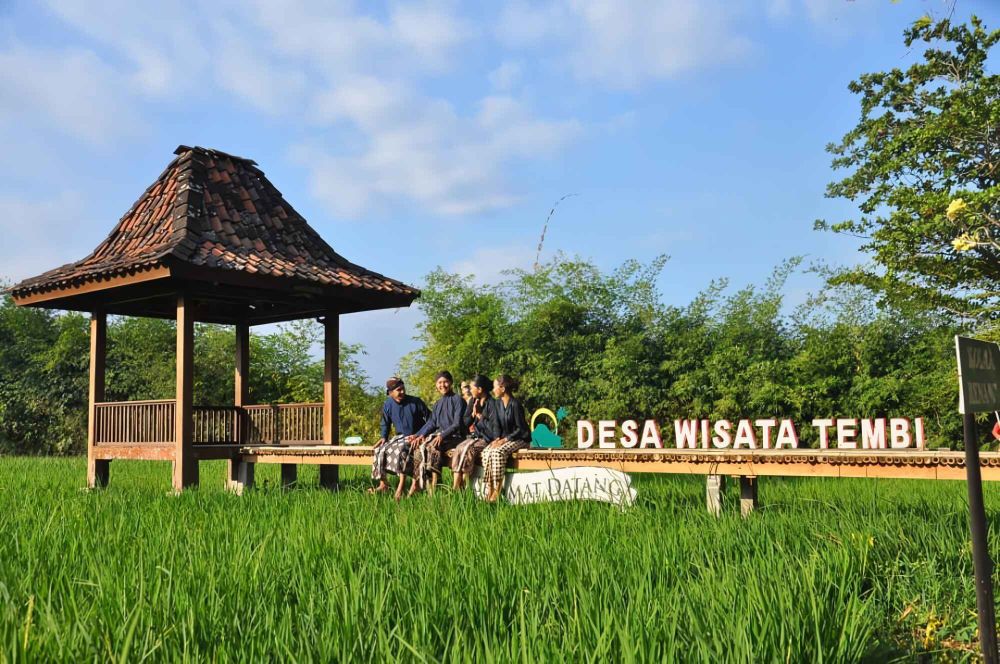
Tembi Village was officially designated a tourist village in 1997, located around 8 km south of Yogyakarta, the village is known for its pristine rural beauty, the local wisdom of its people, and the Tembi Cultural House Museum, which houses a collection of antiques and offers a variety of engaging cultural activities.
The Village have some interesting points such as natural beauty: It boasts a serene village atmosphere with cool air and beautiful rice fields. The community preserves various local crafts such as batik and pottery. There is a museum exhibiting various Javanese cultural collections, such as traditional tools, weapons, and ancient photographs, and serves as a center for arts activities such as theater, dance, and music.
Visitors can enjoy traditional dishes such as sagon and participate in bancakan (a communal meal on banana leaves). Tembi Village offers a variety of activities such as cycling around the village, learning to plant rice, batik-making, Eco-Print Batik and art performances.
Tembi Tourism Village has successfully managed its area, making it a worthy and popular cultural tourism destination. Several homestays in Tembi received awards from the ASEAN Tourism Forum (ATF) in 2016 and 2019. In 2015, Tembi Tourism Village won first place in Bantul Regency and the consolation prize in the Special Region of Yogyakarta.
14. Desa Wukirsari / Wukirsari Village
source : Pemda DIY
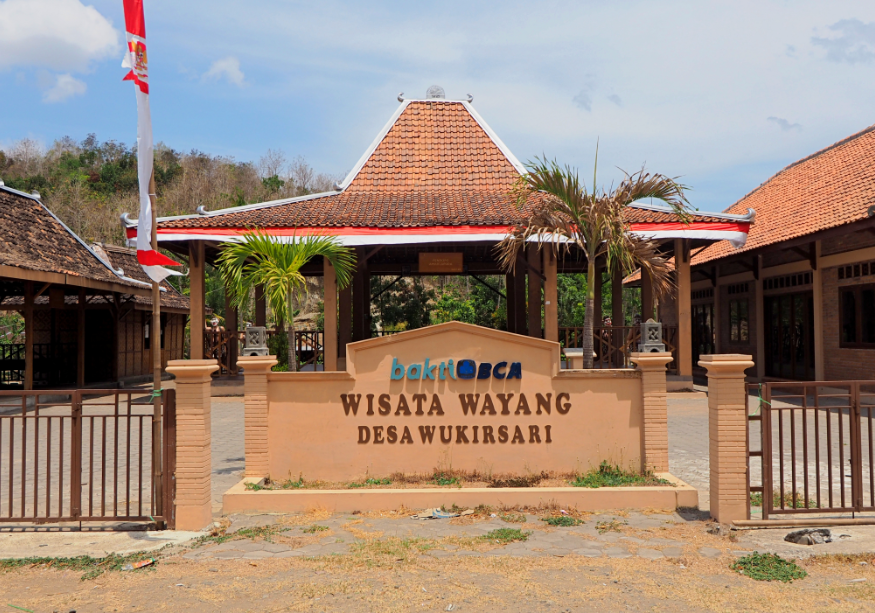
Wukirsari Village, located around 17 km south of Yogyakarta city, in Imogiri District, Bantul Regency, Yogyakarta Special Region, is a tourist village renowned for its rich culture and natural beauty. The village has received numerous prestigious awards, including being recognized as one of the best tourist villages in the world’s 55 best tourist villages by the United Nations World Tourism Organization (UNWTO) in 2024. One of the key assessments from the UNWTO is the village’s commitment to zero waste management.
Indonesian Tourism Village Award (2023): Prior to global recognition, the village also received the title of Advanced Tourist Village from the Ministry of Tourism and Creative Economy (Kemenparekraf) and was ranked among the top 75 best tourist villages nationwide. The people of Wukirsari Village are known for upholding the values of mutual cooperation, unity, and togetherness to achieve shared success. The friendliness of the villagers is also a draw for tourists. With its combination of natural beauty, rich culture, and friendly residents, Wukirsari is a tourist destination that offers unforgettable experiences for visitors.
Main Attractions Wukirsari is a center for hand-drawn batik, especially in Giriloyo Batik Village, which has been a center of this craft since the 17th century. Giriloyo batik is recognized as a cultural heritage by UNESCO. Visitors can learn firsthand the batik-making process. In addition to batik, this village is also known as a center for shadow puppet crafts, a traditional craft passed down through generations. Visitors can learn how to make and color the puppets.
The village is home to the Imogiri Kings’ Tombs, which are a pilgrimage and spiritual tourism destination. These tombs bring a rich history and legend to the village.
Wukirsari offers beautiful natural scenery, including Watu Gagap Hill, which offers a captivating panorama. There is also the Blue Lagoon, a natural pool in the center of the village. As part of the educational tourism program, visitors can participate in various activities, such as mixing wedang uwuh ( traditional herbs drink) and making knitted ornaments.
15. Jamu – Tradional Herbs Drinks

source : Alodokter
Jamu is a traditional herbal medicine that has been used by Indonesians since ancient times to maintain health and treat various ailments. To this day, jamu remains popular and widely consumed.
Below is several kind of Jamu and Their Benefits
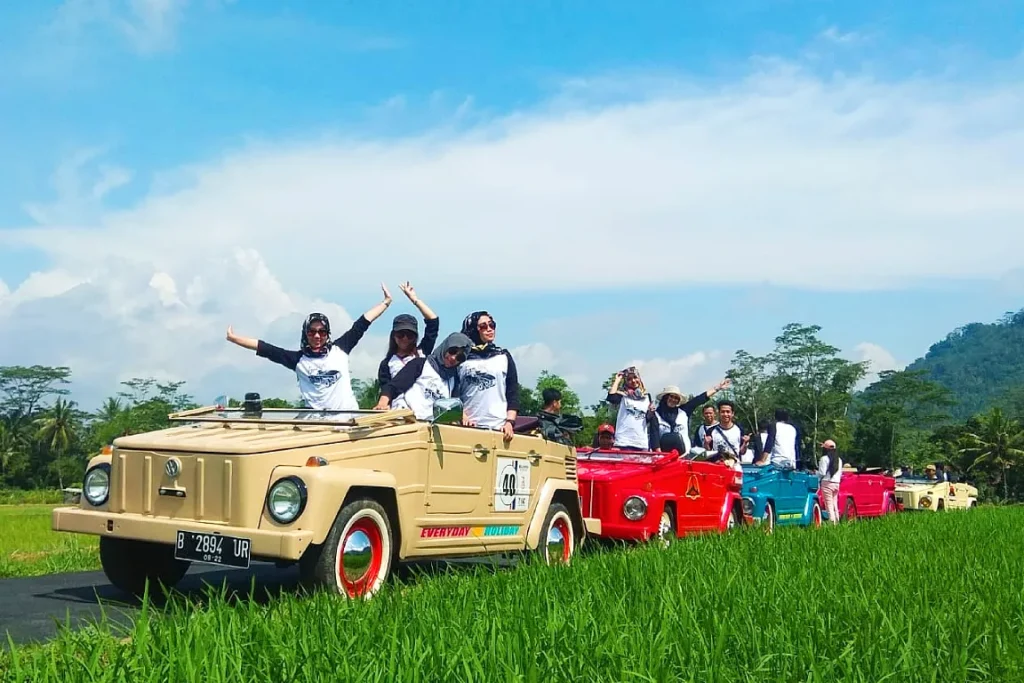
The VW Borobudur Safari is a tour package that explores the villages surrounding Borobudur Temple in a classic open-top Volkswagen (VW) Safari. This experience offers a beautiful rural setting, rice paddy views, and interaction with local residents.
Several Educational and cultural tourism could be visited during this VW Safari such as,
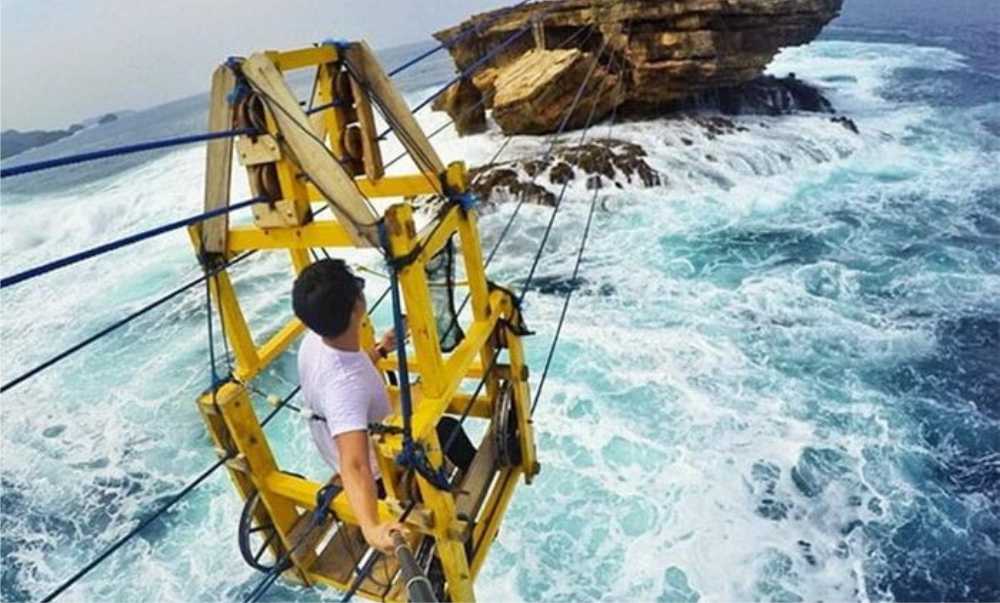
Like most beaches in the Gunung Kidul area, Timang Beach consists of a stretch of white sand surrounded by pandanus trees. This beach has not been extensively developed, so the scenery still feels natural. Timang Beach consists of two sections. The first section on the east is a white sandy beach similar to most beaches. The second section on the west is a steep rocky hill that directly borders the sea. This section offers views of the island or large rocks across the beach. Locals call these islands or large rocks Batu Panjang, Pulau Panjang, and Pulau Timang. Panjang Island is known as a prime spot for lobster hunting. Timang Beach and Panjang Island are connected by a cable car, operated by a rope that connects the beach to the top of the island. The rope is 4 cm in diameter and approximately 200 meters long. Locals often use the cable car to go fishing for fish and lobster on Panjang Island.
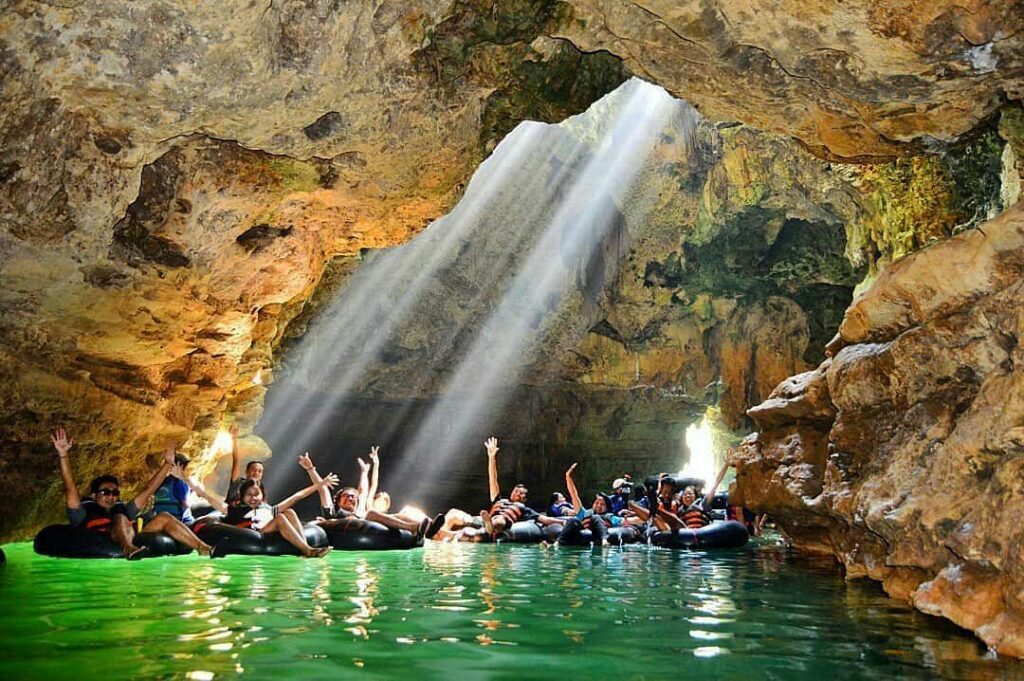
Pindul Cave is a tourist attraction in the form of a cave located in Bejiharjo Village, Karangmojo District, Gunungkidul Regency. Pindul Cave is known for the way to explore the cave which is done by riding a tire above the underground river flow inside the cave, this activity is known as cave tubing. The underground river flow starts from the cave mouth to the end of the cave, inside the cave there is a narrow section that can only be passed by one tire, so usually tourists will take turns one by one to pass through this section. The length of Pindul Cave is 350 meters with a width of 5 meters and a distance of 4 meters from the water surface to the cave roof. Exploring Pindul Cave takes approximately one hour and ends at a dam. The river flow inside Pindul Cave originates from the Gedong Tujuh spring. The Pindul Cave tourist attraction was inaugurated on October 10, 2010.
Bejiharjo Village is located in a karst hilly area, so it is dominated by rocks. Pindul Cave can be reached from Yogyakarta city by private vehicle such as motorcycle or car via Wonosari Road, located approximately 7 km north of Wonosari city. After entering Bejiharjo Village, the journey continues along the asphalt road. The Pindul Cave secretariat is located at the end of the road. Exploring the cave will reveal stalactite rock formations, a type of secondary mineral that hangs from the ceiling of limestone caves. Some stalactites have even grown down to form pillars. Some karst rocks are still alive and drip water. Pindul Cave is divided into three zones: bright, dim, and dark. One part of Pindul Cave has a space wide enough to resemble a pool, with a gap wide enough for sunlight to enter. This gap can also be used as an entrance by entering the cave vertically. Tourist attractions around Pindul Cave include GelatikCave (a dry cave), a monument left by General Soedirman, and the Sokoliman archaeological site.
19. Sri Gethuk Waterfall
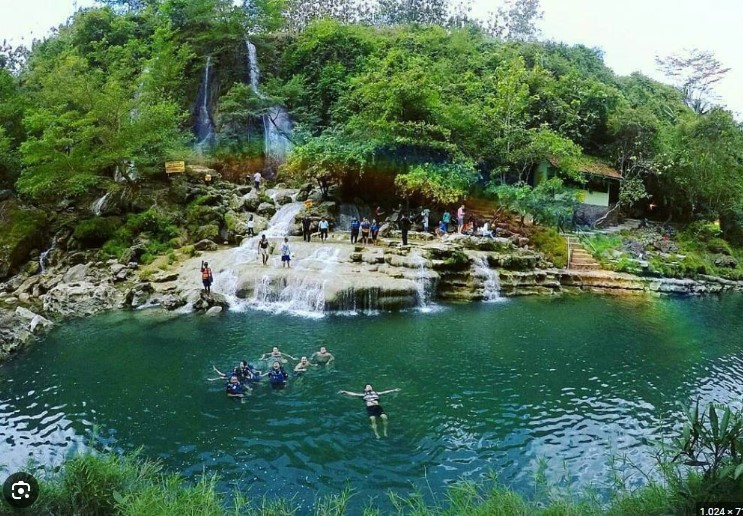
Sri Gethuk Waterfall is a natural tourist attraction located in Playen District, Gunungkidul Regency, Yogyakarta. Situated on the banks of the Oyo River, the waterfall requires a raft ride along the river. Along the way, you’ll be treated to views of limestone cliffs and lush trees. During the dry season, the river water is crystal clear, greenish, and calm.
Sri Gethuk Waterfall has three springs: Ngandong, Dong Poh, and Ngumbul. These three springs converge and flow over a high cliff to form Sri Gethuk Waterfall. Sri Gethuk Waterfall is approximately 25 meters high with 3-5 cascades depending on the season. The ever-flowing water doesn’t form a pool but instead cascades directly over the neat limestone rocks along the riverbank. This waterfall is currently under development to become a leading tourist destination in Gunungkidul Regency, alongside the beaches and karst mountains.
Sri Gethuk Waterfall is also known as Slempret Waterfall. The name Slempret itself comes from a legend in Bleberan Village. According to local legend, this waterfall is the center of spirits led by Jin Anggo Menduro. The waterfall originates from three springs: Kedungpoh, Ngandong, and Ngumbul. These three springs flow together, forming droplets of water that fall from the barren karst cliffs.